



Working with Complex Numbers
Purplemath
What are complex numbers?
A complex number is the sum (or difference) of a real number and an imaginary number (that is, a number that contains the number i). If a and b are regular numbers, then a + bi is a complex number.
Complex numbers are "binomials" of a sort, and are added, subtracted, and multiplied in a similar way. (Division, which is further down the page, is a bit different.)

First, though, you'll probably be asked to demonstrate that you understand the definition of complex numbers.
- Solve 3 − 4i = x + yi for the values of x and y
Finding the answer to this involves nothing more than knowing that two complex numbers can be equal only if their real and imaginary parts are equal. In other words, 3 must equal x and −4 = y.
To simplify complex-valued expressions, you combine "like" terms and apply the various other methods you learned for working with polynomials.
What are some examples of adding complex numbers?
- Simplify (2 + 3i) + (1 − 6i).
To simplify, I will group together the regular numbers and the imaginary numbers, do any addition or subtraction, and then write my answer in standard form.
(2 + 3i) + (1 − 6i)
= (2 + 1) + (3i − 6i)
= 3 + (−3i)
= 3 − 3i

- Simplify (5 − 2i) − (−4 − i).
(5 − 2i) − (−4 − i)
= (5 − 2i) − 1(−4 − i)
= 5 − 2i − 1(−4) − 1(−i)
= 5 − 2i + 4 + i
= (5 + 4) + (−2i + i)
= (9) + (−1i)
= 9 − i
Many students find it helpful to insert the "understood 1" in front of the second set of parentheses (highlighted in red above). This can help the student better keep track of the "minus" being multiplied through the parentheses.
How do you multiply two complex numbers?
To multiply two complex numbers, use the techniques that you learned for multiplying binomials. (This may have been called "FOIL-ing" in your earlier studies.) Then remember that i 2 = −1, and use this fact to simplify further.
What is an example of multiplying complex numbers?
- Simplify (2 − i)(3 + 4i).
I will multiply this out in the same way that I would multiply out (2 − x)(3 + 4x), but I will remember to check for an i 2. I can convert it to a −1, and simplify further.
(2 − i)(3 + 4i)
= (2)(3) + (2)(4i) + (−i)(3) + (−i)(4i)
= 6 + 8i − 3i − 4i2
= 6 + 5i − 4(−1)
= 6 + 5i + 4
= 10 + 5i
As the example above demonstrates, FOILing works for this kind of multiplication, if you learned that method. You can also multiply vertically, if you prefer.
But whatever method you use, remember that multiplying and adding with complex numbers works just like multiplying and adding polynomials, except that, while x2 is only ever just x2, i2 can be simplified to the value −1. You can use the exact same techniques for simplifying complex-number expressions as you do for polynomial expressions, but you can simplify even further with complexes because i2 reduces to the number −1.
Adding and multiplying complexes isn't too bad. It's when you work with fractions (that is, with division) that things turn ugly.
Most of the reason for this ugliness is actually arbitrary. Remember back in elementary school, when you first learned fractions? Your teachers would gag if you used "improper" fractions. You couldn't say "3/2"; you had to convert it to "1 1/2". But now that you're in algebra, nobody cares, and you've probably noticed that "improper" fractions are often much more useful than are "mixed" numbers.
The corresponding issue with complex numbers has to do with denominators again. If you are told to simplify a fraction with the imaginary i in the denominator, you are expected to "rationalize" that denominator. Your instructors will become very cross with you if you leave any imaginaries lurking in denominators. So how do you handle this?
- Simplify

This fraction is pretty "simple" already, but they want me to get rid of that i underneath, in the denominator. The 2 in the denominator is fine, but the i has got to go.
To accomplish this, I will use the fact that i2 = −1. If I multiply the fraction, top and bottom, by i, then the i underneath will vanish in a puff of negativity:
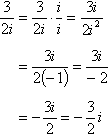
So my "simplified" answer is 
This was easy enough, but what if they give you something more complicated?
What is an example of rationalizing a complex denominator?
- Simplify

If I multiply this fraction, top and bottom, by i, I'll get:
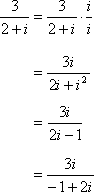
Since I still have an i underneath, this didn't help much. So how do I handle this simplification? I use something called "conjugates". The conjugate of a complex number a + bi is the same number, but with the opposite sign in the middle: a − bi. When you multiply conjugates, you are, in effect, multiplying to create something in the pattern of a difference of squares:
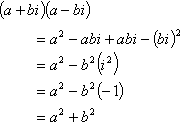
Note that the i's disappeared, and the final result was a sum of squares. This is what the conjugate is for, and here's how it is used:
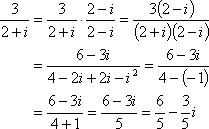
So the answer is 
In the last step, note how the fraction was split into two pieces. This is because, technically speaking, a complex number is in two parts, the real part and the i part. They aren't supposed to "share" the denominator. To be sure your answer is completely correct, split the complex-valued fraction into its two separate terms.
© 2024 Purplemath, Inc. All right reserved. Web Design by 