



Polynomials: Definitions & Evaluation

What is a polynomial?
Polynomial are sums (and differences) of polynomial "terms". For an expression to be a polynomial term, any variables in the expression must have whole-number powers (or else the "understood" power of 1, as in x1, which is normally written as x).
A plain number can also be a polynomial term. In particular, for an expression to be a polynomial term, it must contain no square roots of variables, no fractional or negative powers on the variables, and no variables in the denominators of any fractions. Here are some examples:
This is NOT a polynomial term...
6x −2
...because the variable has a negative exponent.
This is NOT a polynomial term...
...because the variable is in the denominator.
This is NOT a polynomial term...
...because the variable is inside a radical.
This IS a polynomial term...
4x2
...because it obeys all the rules.
This is also a polynomial term...
...because the variable itself has a whole-number power.
That last example above emphasizes that it is the variable portion of a term which must have a whole-number power and not be in a denominator or radical. The numerical portions of a term can be as messy as you like. (But, at least in your algebra class, that numerical portion will almost always be an integer..)
How do terms create polynomials?
To create a polynomial, one takes some terms and adds (and subtracts) them together. Here is a typical polynomial:
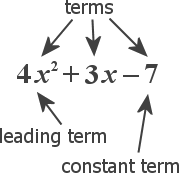
Notice the exponents (that is, the powers) on each of the three terms. The first term has an exponent of 2; the second term has an "understood" exponent of 1 (which customarily is not included); and the last term doesn't have any variable at all, so exponents aren't an issue. Because there is no variable in this last term, it's value never changes, so it is called the "constant" term.
(Note: If one were to be very technical, one could say that the constant term includes the variable, but that the variable is in the form "x0". The variable having a power of zero, it will always evaluate to 1, so it's ignored because it doesn't change anything: 7x0 = 7(1) = 7.)
Notice also that the powers on the terms started with the largest, being the 2, on the first term, and counted down from there. Another word for "power" or "exponent" is "order". When the terms are written so the powers on the variables go from highest to lowest, this is called being written "in descending order". Polynomials are usually written in descending order, with the constant term coming at the tail end. (Note: Some instructors will count an answer wrong if the polynomial's terms are completely correct but are not written in descending order.)
The first term in the polynomial, when that polynomial is written in descending order, is also the term with the biggest exponent, and is called the "leading" term.
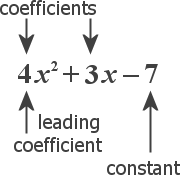
If the variable in a term is multiplied by a number, then this number is called the "coefficient" (koh-ee-FISH-int), or "numerical coefficient", of the term. The coefficient of the leading term (being the "4" in the example above) is the "leading coefficient". If there is no number multiplied on the variable portion of a term, then (in a technical sense) the coefficient of that term is 1.
The exponent on the variable portion of a term tells you the "degree" of that term. For instance, the power on the variable x in the leading term in the above polynomial is 2; this means that the leading term is a "second-degree" term, or "a term of degree two". The second term is a "first degree" term, or "a term of degree one".
In any polynomial, the degree of the leading term tells you the degree of the whole polynomial, so the polynomial above is a "second-degree polynomial", or a "degree-two polynomial".
What is an example of finding the degree of a polynomial?
-
Give the degree of the polynomial, and give the values of the leading coefficient and constant term, if any, of the following polynomial: 2x5 − 5x3 − 10x + 9
This polynomial has four terms, including a fifth-degree term, a third-degree term, a first-degree term, and a term containing no variable, which is the constant term.
The largest power on any variable is the 5 in the first term, which makes this a degree-five polynomial, with 2x5 being the leading term. The numerical portion of the leading term is the 2, which is the leading coefficient.
There is a term that contains no variables; it's the 9 at the end.
degree: 5
leading coefficient: 2
constant: 9
-
Determine the degree of the polynomial, and list the values of the leading coefficient and the constant term, if any, of the following polynomial: 6x2 + 7x4 + x
This polynomial has three terms: a second-degree term, a fourth-degree term, and a first-degree term. There is no constant term.
The three terms are not written in descending order, I notice. The 6x2, while written first, is not the "leading" term, because it does not have the highest degree. The highest-degree term is the 7x4, so this is a degree-four polynomial. Also, this term, though not listed first, is the actual leading term; its coefficient is 7.
degree: 4
leading coefficient: 7
constant: none
What does the word "polynomial" mean?
The "poly-" prefix in "polynomial" means "many", from the Greek language. (The "-nomial" part might come from the Latin for "named", but this isn't certain.) I suppose, technically, the term "polynomial" should refer only to sums of many terms, but "polynomial" is used to refer to anything from one term to the sum of a zillion terms. However, the shorter polynomials do have their own names, according to their number of terms.
What are the names for 1-, 2-, and 3-terms polynomials?
- monomial: a one-term polynomial, such as 2x or 4x2 ("mono-" meaning "one")
- binomial: a two-term polynomial, such as 2x + y or x2 − 4 ("bi-" meaning "two")
- trinomial: a three-term polynomial, such as 2x + y + z or x4 + 4x2 − 4 ("tri-" meaning "three")
I don't know if there are names for polynomials with a greater numbers of terms; I've never heard of any names other than the three that I've listed.
How are polynomials named for their degrees?
- linear: a first-degree polynomial, such as 6x or −x + 2 (because it graphs as a straight line)
- quadratic: a second-degree polynomial, such as 4x2, x2 − 9, or ax2 + bx + c (from the Latin "quadraticus", meaning "made square")
- cubic: a third-degree polynomial, such as −6x3 or x3 − 27 (because the variable in the leading term is cubed, and the suffix "-ic" in English means "pertaining to")
- quartic: a fourth-degree polynomial, such as x4 or 2x4 − 3x2 + 9 (from the Latic "quartus", meaning "fourth")
- quintic: a fifth-degree polynomial, such as 2x5 or x5 − 4x3 − x + 7 (from the Latic "quintus", meaning "fifth")
There are names for some of the polynomials of higher degrees, but I've never heard of any names being used other than the ones I've listed above.
If "quad" stands for 4, why is a degree-2 polynomial called a "quadratic"?
Yes, the prefix "quad" usually refers to "four", as when an atv is referred to as a "quad bike", or a drone with four propellers is called a "quad-copter". For polynomials, however, the "quad" in "quadratic" is derived from the Latin for "making square". As in, if you multiply a length by a width (of, say, a room) to find the area, the units on the area will be raised to the second power. For instance, the area of a room that is 6 meters by 8 meters is 48 m2. So the "quad" for degree-two polynomials refers to the four corners of a square, from the geometrical origins of parabolas and early polynomials.
What does it mean to "evaluate" a polynomial?
"Evaluating" a polynomial is the same as evaluating anything else; that is, you take the value(s) you've been given, plug them in for the appropriate variable(s), and simplify to find the resulting value.
What is an example of evaluating a polyomial?
-
Evaluate 2x3 − x2 − 4x + 2 at x = −3
I need to plug in the value −3 for every instance of x in the polynomial they've given me, remembering to be careful with my parentheses, the powers, and the "minus" signs:
2(−3)3 − (−3)2 − 4(−3) + 2
2(−27) − (+9) + 12 + 2
−54 − 9 + 14
−63 + 14
−49
-
Evaluate x5 + 4x4 − 9x + 7 at x = −2
I'll plug in a −2 for every instance of x, and simplify:
(−2)5 + 4(−2)4 − 9(−2) + 7
(−32) + 4(16) − (−18) + 7
−32 + 64 + 18 + 7
−32 + 89
57
When evaluating, always remember to be careful with the "minus" signs!
© 2024 Purplemath, Inc. All right reserved. Web Design by 