



Solving More-Advanced Systems of Non-Linear Equations
Purplemath
The basic process for solving more complicated systems of non-linear equations remains the same as for the previous systems; namely, solve one of the equations for one of the variables, plug that information into the other equation, and solve the resulting one-variable equation.

In "real life", naturally, you can expect advanced systems of non-linear equations to generally *not* be algebraically solvable. (Instead, you would have to use technology — a graphing calculator, a dedicated numerical package, etc.)
Thankfully, though, you can safely expect that the systems they give you in your algebra and calculus classes will be solvable. It just might take some time... and plenty of scratch-paper.
- Solve the system of nonlinear equations:
y = x2
x2 + (y − 2)2 = 4
From the form of the equations, I (should) know that this system contains a parabola and a circle. Assuming that the two curves touch or cross, there might be one, two, three, or four intersection points. I'll have to do the algebra to find out.
According to the graph, I see that there should be three solutions to this system:
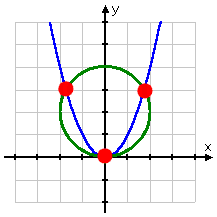
The solution at the origin is pretty clear (though I still need to prove that the curves do in fact touch at the origin), but the other two intersection points' coordinates may be messy.
From the first equation, I think I'll plug in "y" in place of "x2" in the second equation, and solve:
x2 + (y − 2)2 = 4
y + (y − 2)2 = 4
y + (y2 − 4y + 4) = 4
y 2 − 3y = 0
y (y − 3) = 0
y = 0, y = 3
Okay; I've got two values for y. Now I need to find the corresponding x-values. I'll find them by plugging the y-values back into the first equation.
When y = 0, the corresponding x-value is:
y = x2
0 = x2
0 = x
(This is the solution at the origin that I'd been expecting.)
When y = 3, the corresponding x-value is:
Then my solutions are the following three points:


- Solve the following system:
3x2 + 2y2 = 35
4x2 − 3y2 = 24
Yikes! Okay...
I can rearrange the first equation to get:

This tells me that the first equation is an ellipse. However, rather than graphing this using ellipse formulas, I can also solve to get a "plus-minus" expression that I can graph as two equations:
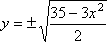
(To graph this, I would plug this into my graphing calculator as two graphs, one graph for the "plus" part of the ellipse, and another for the "minus" part.)
The second equation rearranges as:

...which is an hyperbola. The second equation also solves (for use in my graphing calculator) as:

Whatever format I end up using (the ellipse and the hyperbola center-vertex forms, or the "plus-minus" for-calculator forms), this system graphs as:
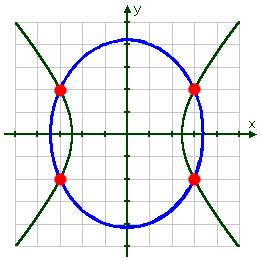
From what I can see, there appear to be four solutions to this system. To find these solutions algebraically, I will choose to solve the second equation for x2 (rather than just x), and plug the resulting expression into the first equation, which I will then solve for y.

(It's okay that I "only" solve for x2, because neither equation has a linear x-term. There is no need, in this particular case, to do any more solving.)
Then, subsituting into the first equation for the x2, I get:
So I've found two values for y. I'll plug each of these values into the second equation, and solve for the corresponding values of x.
When y = −2, the corresponding value of x is:
Okay; so I got two values of x for when y = −2. I suspect I'll get two values for when y = +2, as well.
When y = 2, the corresponding value of x is:
Then my solution consists of the following four points:
(−3, −2), (−3, 2), (3, −2), (3, 2)
Note: In this one specific sort of case, the points can also be written as (±3, ± 2), since all of the "plus-minus" combinations are included. This is not, in general, true; you are not, in general, able to combine the coordinates like this.
To keep yourself on the safe side — that is, to avoid accidentally combining coordinates that don't actually go together — it's probably a good idea always to list out the various solution points, like I did at the end of the last exercise above.
Also, I *could* have solved this last system maybe quicker if I'd tried the addition method. If I'd multiplied the first equation by 3 and the second equation by 2, I'd have gotten:
Then x2 = 9, so x = ±3. Plugging these values back into one of the original equations would then return the corresponding y-values.
If you happen to notice that the addition method will work to get you started, then don't be afraid to use this other method. There is no rule that says that you absolutely must use substitution the whole way through.
© 2024 Purplemath, Inc. All right reserved. Web Design by 