



Solving Intermediate-Difficulty Systems of Non-Linear Equations
Purplemath
The non-linear systems we've solved so far have been one quadratic equation and one linear equation, which graphed as a parabola and a straight line, respectively. Moving up in difficulty, we come to solving systems of two quadratic equations (which can graph as two parabolas) and other, slightly more messy systems.

- Solve the following system:
y = 2x2 + 3x + 4
y = x2 + 2x + 3
As before, I'll set these equations equal, and solve for the values of x:
2x2 + 3x + 4 = x2 + 2x + 3
x2 + x + 1 = 0
Using the Quadratic Formula:
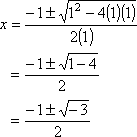
But I can't graph that negative inside the square root! What's going on here?
Lemme take a quick look at the graph:
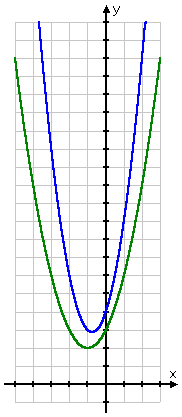
The lines do not intersect; *that's* what's going on! Since there is no intersection on the graph, then there is no solution to the system. That is, this is an inconsistent system. My final answer is:
no solution / inconsistent system
What method do you use for solving systems of nonlinear equations?
In general, the method I use for solving general systems of non-linear equations is the method of substitution:
- I solve one of the equations (I choose which) for one of the variables (again, I choose which).
- I plug the resulting expression into the other equation in place of the chosen variable.
- I solve for the value(s) of the other variable.
- I plug those solutions back into the first equation, and solve for the corresponding values of the first variable.
I may also do a quick graph in my graphing calculator, in order to check my work.
Are there other methods for solving systems of nonlinear equations?
On rare occasions, two equations may have bits that could cancel off if the equations were added together (that is, the solution could be started by addittion, rather than by substitution). For instance, consider the following pair of equations:
−y = +x2 + 3x
+y = −x2 − 7x + 5
If these equations are added together, we get:
0 = −4x + 5
x = 5/4 = 1.25
Then this x-value would be plugged into either original equation, in order to find the corresponding value of y. But this sort of set-up is fairly uncommon.
- Solve the following system:
y = −x − 3
x2 + y2 = 17
Graphically, this system is a straight line (from the first equation) crossing a circle centered at the origin (from the second equation):
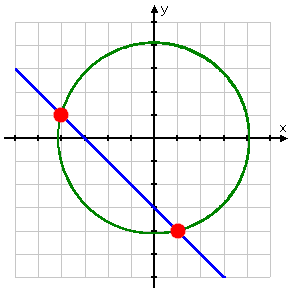
There appear to be two solutions. I'll proceed algebraically to confirm this impression, and to get the exact values.
Since the first equation is already solved for y, I will plug "−x − 3" in for "y" in the second equation, and solve for the values of x:
x2 + y2 = 17
x2 + (−x − 3)2 = 17
x2 + (−x − 3)(−x − 3) = 17
x2 + (x2 + 6x + 9) = 17
2x2 + 6x + 9 = 17
2x2 + 6x − 8 = 0
x2 + 3x − 4 = 0
(x + 4)(x − 1) = 0
x = −4, x = 1
When x = −4, then:
y = −x − 3
= −(−4) − 3
= 4 − 3 = 1
When x = 1, then:
y = −x − 3
= −(1) − 3
= −4
Then my solution consists of the following two points:
(−4, 1), (1, −4)

Note the procedure I used for solving the system:
I solved one of the equations (the first equation looked easier) for one of the variables (solving for "y=" looked easier), and then plugged the resulting expression back into the other equation. This gave me one equation in one variable (the variable happened to be x) — and a one-variable equation is something I know how to solve.
Once I had the solution values for x, I back-solved for the corresponding y-values. I emphasize "corresponding" because you have to keep track of which y-value goes with which x-value.
In the example above, the points (−4, −4) and (1, 1) were not solutions. Even though I came up with x = −4 and x = 1 and y = −4 and y = 1, the x = −4 did not go with the y = −4, and the x = 1 did not go with the y = 1.
You must match the x-values and y-values correctly. Be careful!
- Solve the following system of equations:
y = (½)x − 5
y = x2 + 2x − 15
Since both equations are already solved for y, I'll set them equal and solve for the values of x:
(½)x − 5 = x2 + 2x − 15
x − 10 = 2x2 + 4x − 30
0 = 2x2 + 3x − 20
0 = (2x − 5)(x + 4)
When , then the corresponding y-value is:
And when x = −4, then the corresponding y-value is:
Then my solutions for this system are at the following two points:
Graphically, the above system looks like this:
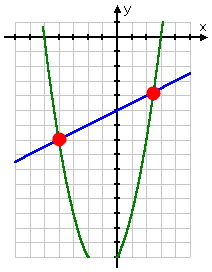
The intersection points on the graph appear to be good matches for the numerical solutions I got by doing the algebra, confirming (to my satisfaction, *before* I hand in my work) that I've done the exercise correctly.
- Solve the following system of equations:
xy = 1
x + y = 2
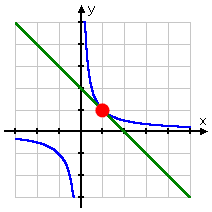
Taking a quick look at these equations, I see something new: the variables are multiplied together in the first equation. This might lead to some extra complexity in the algebra for solving this system.
Taking a quick look at the graph, I see that there appears to be only one solution:
Hmm... I guess I'll solve the second equation for y=, and plug the result into the first equation in place of the y:
x + y = 2
y = −x + 2
Plugging the expression for the right-hand side above into the first of the original equations in place of the y, I get:
xy = 1
x(−x + 2) = 1
−x2 + 2x = 1
−x2 + 2x − 1 = 0
x2 − 2x + 1 = 0
(x − 1)(x − 1) = 0
x = 1
(Sneaking a glance at the graphed system, above, I see that the x-value for my solution appears to match the one marked intersection point. Good.)
Plugging this x-value into the second equation, I get:
x + y = 2
(1) + y = 2
y = 1
(Checking the graph above, I see that this value also appears to match the marked point. Excellent!)
Then my system solution is a single point:
(1, 1)
Again, the picture didn't prove anything, and giving an answer of "this is what it looks like on my graphing calculator" would not get me many points. But, as long as you've got the graphing calculator and you're doing the actual algebra, there's no harm in looking at the picture to check your work.
© 2024 Purplemath, Inc. All right reserved. Web Design by 