



Solving Simple Systems of Nonlinear Equations
Purplemath
Is there a formula for systems of nonlinear equations?
There is no formula for solving systems of non-linear equations. This is because, even when restricted to just two equations in two variables, there are so many options for the equations in the system.

What is the best method for solving systems of non-linear equations?
Usually, solving one of the equations for one of the variables, and then plugging the result into the other equation and solving for the other variable, is most efficient in arriving at solutions. But there is no one best method for solving systems of nonlinear equations. Graphing can be helpful for suggesting what and where your answer(s) might lie, but the algebra (for *proving* solutions) is generally best served by using substitution.
To find the exact solution to a system of equations, you must use algebra. Let's look again at that first system of non-linear equations on the previous page:
- Solve the following system algebraically:
y = x2
y = 8 − x2
Since I am looking for the intersection points, I am therefore looking for the points where the equations overlap, where they share the same values. That is, I am trying to find any spots where y = x2 equals y = 8 − x2:
y = x2 = y = 8 − x2
The algebra comes in when I manipulate useful bits of this last equation. I can pick out whichever parts I like. (They're all equal, after all — at least at the intersection points, but the intersection points are the only points that I care about anyway!) So I can pick out any of the following:
y = x2
y = 8 − x2
y = y
x2 = 8 − x2
Each of these sub-equations is true, but only the last one is usefully new and different:
x2 = 8 − x2
I can solve this for the x-values that make the equation true:
x2 = 8 − x2
2x2 = 8
x2 = 4
x = −2, +2
Then the solutions to the original system will occur when x = −2 and when x = +2.
What are the corresponding y-values? To find them, I plug the x-values back in to either of the two original equations. (It doesn't matter which one I pick because I only care about the points where the equations spit out the same values. So I can pick whichever equation I like better.)
I'll plug the x-values into the first equation, because it's the simpler of the two:
x = −2:
y = x2
y = (−2)2 = 4
x = +2:
y = x2
y = (+2)2 = 4
Then the solutions (as we already knew, from looking at the graph earlier) are at:
(x, y) = (−2, 4), (2, 4)
In the above example, the solutions were nice, neat integer values; no fractions or decimals or radicals. But solutions will not always be neat. So, while the pictures can be very useful for giving you a feel for what is going on, graphing is not as accurate as doing the algebra.
Warning: Students are often taught nowadays to round absolutely everything, and are thus implicitly taught that all answers will actually be nice, neat whole numbers. But this is wrong. Don't fall for it!
For instance:
- Solve the following system:
y = x2 + 3x + 2
y = 2x + 3
I can solve this in the same manner as I did on the previous problem. The solution to the system will be any point(s) that the lines share; that is, any point(s) where the x-value and corresponding y-value for y = x2 + 3x + 2 is the same as the x-value and corresponding y-value for y = 2x + 3; that is, where the lines overlap or intersect; that is, where y = x2 + 3x + 2 equals y = 2x + 3.
Looking at a quick graph of the system:
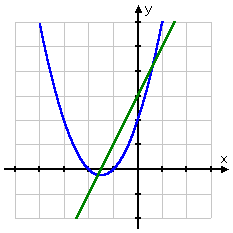
...I can see that there appear to be solutions at around (x, y) = (−1.5, −0.25) and (x, y) = (0.5, 4.25). But I cannot assume that this is the answer! The picture can give me a good idea, but only the algebra can give me the actual answer.
(If my algebra leads me to an answer that is nowhere close to the intersections on the graph, then I know that I need to check my work, and check what I plugged into the graphing calculator.)

I'll set the right-hand sides of the two equations equal to each other, and solve:
x2 + 3x + 2 = 2x + 3
x2 + x − 1 = 0
Using the Quadratic Formula gives me:
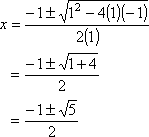
Then I have one solution (from the "minus;" in the "±" in front of the radical) that is:

...which has a corresponding y-value of:
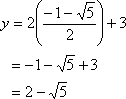
The other solution (from the "plus" in the "±" in front of the square root) is:

....which gives me a y-value of:
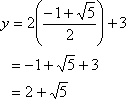
So the solutions are:
![([-1 - sqrt(5)]/2, 2 - sqrt(5)) and ([-1 + sqrt(5)]/2, 2 + sqrt(5))](systems/sysgen20.gif)
For purposes of graphing, the *approximate* solutions are:
(x, y) = (−1.62, −0.24), (0.62, 4.24)
In other words, while my guess from the picture was pretty close, it was not entirely correct, nor was it "exact" the way the radical-containing expressions are.
© 2024 Purplemath, Inc. All right reserved. Web Design by 