



Solving Quadratic Equations by Completing the Square
Purplemath
The quadratic equation in the previous page's last example was:
(x − 2)2 − 12 = 0
The expression on the left-hand side of this equation can be multiplied out and simplified to be:
x2 − 4x − 8
But we still would not have been able to solve the equation, even with the quadratic formatted this way, because it doesn't factor and it isn't ready for square-rooting.
The only reason we could solve it on the previous page was because they'd already put all the x stuff inside a square, so we could move the strictly-numerical portion of the equation to the other side of the "equals" sign and then square-root both sides. They won't always format things as nicely as this. So how do we go from a regular quadratic like the above to an equation that is ready to be square-rooted?
We will have to "complete the square".
Here's how we'd have solved the last equation on the previous page, if they hadn't formatting it nicely for us.
-
Use completing the square to solve x2 − 4x − 8 = 0.
As noted above, this quadratic does not factor, so I can't solve the equation by factoring. And they haven't given me the equation in a form that is ready to square-root. But there is a way for me to manipulate the quadratic to put it into that ready-for-square-rooting form, so I can solve.
First, I put the loose number on the other side of the equation:
x2 − 4x − 8 = 0
x2 − 4x = 8
Then I look at the coefficient of the x-term, which is −4 in this case. I take half of this number (including the sign), which gives me −2. (I need to keep track of this value. It will simplify my work later on.)
Then I square this value to get +4, and add this squared value to both sides of the equation:
x2 − 4x + 4 = 8 + 4
x2 − 4x + 4 = 12
This process creates a quadratic expression that is a perfect square on the left-hand side of the equation. I can factor, or I can simply replace the quadratic with the squared-binomial form, which is the variable, x, together with the one-half number that I got before (and noted that I'd need later), which was −2. Either way, I get the square-rootable equation:
(x − 2)2 = 12
(I know it's a "−2" inside the parentheses because half of −4 was −2. By noting the sign when I'm finding one-half of the coefficient, I help keep myself from messing up the sign later, when I'm converting to squared-binomial form.)
(By the way, this process is called "completing the square" because we add a term to convert the quadratic expression into something that factors as the square of a binomial; that is, we've "completed" the expression to create a perfect-square binomial.)
Now I can square-root both sides of the equation, simplify, and solve:
(x − 2)2 = 12
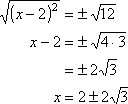
Using this method, I get the same answer as I had before; namely:

-
Solve 2x2 − 5x + 1 = 0 by completing the square.
There is one extra step for solving this equation, because the leading coefficient is not 1; I'll first have to divide through to convert the leading coefficient to 1. Here's my process:
2x2 − 5x + 1 = 0
Now that I've got all the terms with variables on one side, with the strictly-numerical term on the other side, I'm ready to complete the square on the left-hand side. First, I take the linear term's coefficient (complete with its sign), −(5/2), and multiply by one-half, and square:
Then I add this new value to both sides, convert to squared-binomial form on the left-hand side, and solve:
The two terms on the right-hand side of the last line above can be combined over a common denominator, and this is often ("usually"?) how the answer will be written, especially if the instructions for the exercise included the stipulation to "simplify" the final answer:
Elsewhere, I have a lesson just on solving quadratic equations by completing the square. That lesson (re-)explains the steps and gives (more) examples of this process. It also shows how the Quadratic Formula can be derived from this process. If you need further instruction or practice on this topic, please read the lesson at the above hyperlink.
By the way, unless you're told that you have to use completing the square, you will probably never use this method in actual practice when solving quadratic equations. Either some other method (such as factoring) will be obvious and quicker, or else the Quadratic Formula (reviewed next) will be easier to use. However, if your class covered completing the square, you should expect to be required to show that you can complete the square to solve a quadratic on the next test.
© 2024 Purplemath, Inc. All right reserved. Web Design by 