



Completing the Square: Deriving the Quadratic Formula
Purplemath
-
Solve x2 + 10 = −6x
To complete this exercise, I'll apply the same procedure as was demonstrated on the previous page.
First, I'll write down the original equation:
x2 + 10 = −6x
Then I'll rearrange this equation to get the variable-containing terms on the left-hand side, with the constant (the loose number) isolated on the right-hand side:
x2 + 6x = −10
The leading term is multiplied by an "understood" 1, so I don't have to divide through by anything.
Now I'll do the side-calculations, starting with the coefficient of the linear term, including its sign:
numerical coefficient: +6
I'll divide this in half:
derived value:
I'll square this derived value:
square of derived value: (+3)2 = 9
Now I'll return to my last equation-based step, and add this squared value to either side of the equation:
x2 + 6x + 9 = −10 + 9
I can simplify the strictly-numerical stuff on the right-hand side:
x2 + 6x + 9 = −1
Um... Wait a minute... The left-hand side can be restated, in completed-square form, as (x + 3)2, but the right-hand side is a negative. I can't have a squared expression (which must have a value that is zero or positive) on one side, and claim that this is equal to a negative on the other side! The real numbers don't work that way!
If you haven't yet studied complex numbers (being numbers with an "i" in them), then you'd stop at this point, and say that this equation has "no solution". On the other hand, if you have studied complexes, you can continue.
Continuing, I'll convert the left-hand side to completed-square form, using the +3 that I derived earlier:
(x + 3)2 = −1
Now I'll square-root both sides, remembering to put a "plus-minus" on the strictly-numerical right-hand side:
Depending upon my level of study, my answer will either be:
no solution
...or:
Again, if you don't yet know about complex numbers (the numbers with "i" in them), then you would say that the above quadratic has "no solution". If, on the other hand, you do know about complexes, then you would say that this quadratic has "no real solution", but it does have two "complex" solutions.
Since solving "(quadratic) = 0" for x is the same as finding the x-intercepts (assuming the solutions are real numbers), it stands to reason that this quadratic should not intersect the x-axis (since x-intercepts are "real" numbers). As you can see below, the graph does not in fact cross the x-axis.
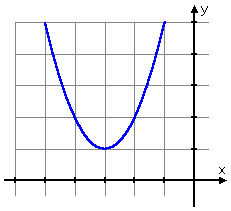
This relationship is always true. If you end up with a non-negative value on the right-hand side of the equation before you take the square roots of each side, then the quadratic will have two x-intercepts (or only one, if you get plus-minus of zero on the right-hand side); if you get a negative value on the right-hand side, then you won't get a real-number solution (because you can't take the square root of a negative within the real numbers), and the quadratic will not cross the x-axis.
I'll do one last "example". It's a hard one, but please bear with me.
It has become somewhat fashionable to have students derive the Quadratic Formula themselves; this is done by completing the square for the generic quadratic equation ax2 + bx + c = 0. While I can understand the impulse (showing students how the Formula was invented, and thereby providing a concrete example of the usefulness of abstract symbolic manipulation), the computations involved are often a bit beyond the average student at this point.
Here is what the instructor is looking for:
-
Derive the Quadratic Formula by solving ax2 + bx + c = 0.
Okay; I'll start this one exactly the same as I did all the others. The only difference in this case will be that, as I go along, I won't be able to simplify stuff, because I have letters instead of numbers.
The original equation is this:
ax2 + bx + c = 0
I'll move the constant term (the loose number) over to the right-hand side:
ax2 + bx = −c
The leading term is multiplied by a, so I'll have to divide through by this "value":
Now I'll need to start my side-calculations with the coefficient of the linear term, including its sign:
numerical coefficient:
I'll multiply this by
derived value:
Now I'll square this derived value:
derived value:
I'll add this squared value to either side of the equation:
I'll rearrange, convert to the common denominator, and combine on the right-hand side:
Then I'll convert the left-hand side to completed-square form, using the value I derived earlier:
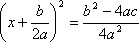
Next comes taking the square roots of either side, remembering the "plus-minus" on the strictly-numerical side:

And I'll finish by solving for the variable:
![x = [ −b ± sqrt(b^2 − 4ac) ] / 2a](square/solve14.gif)
Whether you're working symbolically (as in the last example) or numerically (which is the norm), the key to solving by completing the square is "practice, practice, practice". By so doing, the process will become more "automatic", and you'll be much more likely to remember the steps when you're taking the next test.
© 2024 Purplemath, Inc. All right reserved. Web Design by 