



Factoring "In Pairs"
Purplemath
There is one special case for factoring that you may or may not need, depending upon how your book is structured and how your instructor intends to teach factoring quadratics. I call it "factoring in pairs", but your book may refer to it as "factoring by grouping". By whatever name, this technique is sometimes useful, but mostly it is helpful as a means of introducing how to factor quadratics, which are degree-two polynomials. Or, at least, most textbook authors seem to feel that this is a helpful step along the way from basic factoring to quadratics.
When you're doing basic factoring of polynomials, you're generally taking some common factor out of every term in the polynomial. What happens if they give you four terms, but there's no common factor?
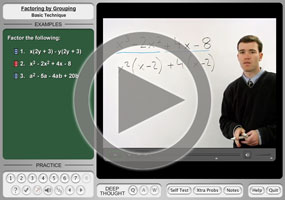
Any time you encounter such a situation, you should try factoring in pairs. It's a pretty safe bet, especially when you're doing factoring before quadratics, that the four-term polynomial they've given you is factorable, and that the method they're expecting you to use is "in pairs".
-
Factor xy − 5y − 2x + 10
Is there anything that factors out of all four terms? No. When I have four terms, and nothing factors out of all of them, I know I need to consider trying to factor "in pairs". To factor in pairs, I first split the expression into two pairs of terms, and then I factor the pairs of terms separately. If I've set things up correctly, I should get a common factor in binomial form.
In this case, I'll leave the four terms in their current order.
xy − 5y − 2x + 10
What can I factor out of the first pair? I can take out a y:
xy − 5y − 2x + 10
= y(x − 5) − 2x + 10
What can I factor out of the second pair? I can take out a −2:
xy − 5y − 2x + 10
= y(x − 5) − 2x + 10
= y(x − 5) − 2(x − 5)
What happened with the signs in the last factorization above? I took out a −2 out of those last two terms, rather than a +2, because the leading sign on the pair was a "minus". And I got a −5 in the parentheses because, when I divided the positive 10 by the negative 2, the result was a negative 5. (Be careful with your signs!)
Now that I do have a common factor, I can proceed as usual:
xy − 5y − 2x + 10
= y(x − 5) − 2(x − 5)
= (x − 5)(y − 2)
Factoring in pairs is most commonly used to introduce factoring quadratics. So you may see exercises that look like this:
-
Factor x2 + 4x − x − 4.
This polynomial has four terms with no factor common to all four, so I'll try to factor in pairs:
x2 + 4x − x − 4
= x(x + 4) − 1(x + 4)
= (x + 4)(x − 1)
Why, in the second line above, did I factor out a 1? Because, if "nothing" factors out, then a 1 factors out.
-
Factor x2 − 4x + 6x − 24.
I have four terms which share no common factors, so I'll try to factor in pairs:
x2 − 4x + 6x − 24
= x(x − 4) + 6(x − 4)
= (x − 4)(x + 6)
Sometimes, they'll give you four terms having no common factors, and it seems like factoring in pairs isn't working. Before you give up, try rearranging the terms into different pairs.
-
Factor x2 + 3y − 3x − xy
I'll try factoring this in pairs, with the terms in their current order. For the second pair of terms, I'll be pulling the "minus" outside of the parentheses, so I'll need to remember to flip the signs inside the parentheses:
(x2 + 3y) − (3x + xy)
1(x2 + 3y) − x(3 + y)
Okay, that didn't work. What if I rearrange the terms? How about if I group, say, the two terms that contain the variable x?
x2 − xy + 3y − 3x
(x2 − xy) + (3y − 3x)
x(x − y) + 3(y − x)
Ooo, so close! If only the subtraction in the second parenthetical were reversed. But, I remember, I can reverse the subtraction; I just have to remember to flip the sign outside of the parentheses. This gives me:
x(x − y) − 3(x − y)
(x − y)(x − 3)
There will be times, as in the above, when one rearrangement of the terms won't quite work. Don't be shy about trying something else.
-
Factor ab − 2 + a − 2b
I can see that the first two terms share no common factors. So I know that, if factoring in pairs is going to work, I'll first have to rearrange the terms. I think I'll try pairing the terms without 2's, and pairing the two other terms with 2's:
ab + a − 2 − 2b
a(b + 1) − 2(1 + b)
a(b + 1) − 2(b + 1)
(b + 1)(a − 2)
By the way, more than one rearrangement of terms can be successful. For instance, suppose that I'd decided to group the terms containing the variable b. Then my steps would have been as follows:
ab − 2b + a − 2
(ab − 2b) + (a − 2)
b(a − 2) + 1(a − 2)
(a − 2)(b + 1)
Yes, the factors are in the opposite order, but order doesn't matter for multiplication. Either answer is correct.
If you will be using factoring in pairs for factoring quadratics (which is not the method I use), your book will refer to this process by terminology such as "factoring by grouping", and the factorization process will work like this:
-
Factor x2 − 5x − 6.
First, I have to find factors of the last term, −6, that add up to the numerical coefficient of the middle term, −5. I'll use the number −6 and +1, because (−6)(+1) = −6, and (−6) + (+1) = −5. Using these numbers, I'll split the middle "−5x" term into the two terms "−6x" and "+1x". This will then allow me to factor in pairs:
x2 − 5x − 6
= x2 − 6x + 1x − 6
= x(x − 6) + 1(x − 6)
= (x − 6)(x + 1)
-
Factor 6x2 − 13x + 6.
This factorization is a bit more complicated, because the leading coefficient (that is, the number on the x2 term) is not a simple 1. But I can still factor the polynomial.
First, I need to find factors of (6)(6) = 36 that add up to −13. I'll use the numbers −9 and −4, because (−9)(−4) = 36, and (−9) + (−4) = −13. Using these numbers, I can split the middle −13x term into the two terms −9x and −4x, and then I can factor in pairs:
6x2 − 13x + 6
= 6x2 − 9x − 4x + 6
= 3x(2x − 3) − 2(2x − 3)
= (2x − 3)(3x − 2)
The factoring method in the last two examples above — in particular, the part where I picked two numbers for splitting the middle term of the quadratic — probably look fairly magical to you right now. That's okay. For a complete explanation of these last two examples, please study my lesson on factoring quadratics. The pages covering the "simple" quadratic factoring and then the "hard" quadratic factoring methods should completely clarify the topic.
© 2024 Purplemath, Inc. All right reserved. Web Design by 