



Factoring Quadratics: The Simple Case
Purplemath
What is a quadratic?
A quadratic is a polynomial that looks like "ax2 + bx + c", where a, b, and c are just numbers. Note that either of b and c, but never a, might be zero, so the quadratic might have fewer than three terms. For this part of the lesson, we'll be looking at quadratics where a = 1.

What is a trinomial?
A trinomial is any polynomial having three terms. Most trinomials are not quadratics, and many quadratics (if either of a and b is zero) are not trinomials. However, for some reason, many textbooks and instructor conflate the two, so they would have titled this page as "Factoring Trinomials: The Simple Case". (I don't know why they introduce this needless confusion.) If you're wanting to learn how to factor ax2 + bx + c, you're come to the right place.
How do you factor quadratics with a leading 1? What is the easiest way?
The simplest way to factor a quadratic with a leading coefficient of 1 is to use these steps:
- Note the values, in x2 + bx + c, of b and c.
- Find factors of c that add up to b. (Let's name those factors as p and q.)
- Factor the quadratic as (x + p)(x + q).
Why does this method work? Here's the logic of it:
For the easy case of factoring quadratic polynomials — that is, the case of factoring quadratics where the leading coefficient is just 1 — we will need to find two numbers that will multiply to be equal the constant term c, and will also add up to equal b, the coefficient on the linear x-term in the middle. Why?
Quadratics are degree-two polynomials. When you were learning how to multiply polynomials together, they probably started you out by multiplying two binomials together (and they may have referred to this process as "foiling").
To end up with a quadratic that had a leading coefficient of 1 (and no fractions), each of the original binomials also had to have had a leading coefficient of 1.
We can see this by looking at two generic binomials; we will use the variable x and the generic numbers p and q. We can multiply the binomials like this:
(x + p)(x + q)
x2 + px + qx + pq
x2 + (p + q)x + pq
In the above, (p + q) = b and pq = c from x2 + bx + c. This multiplication and simplification demonstrates why, to factor a quadratic, we'll need to start by finding the two numbers (being the p and the q above) that add up to equal b, where those numbers also multiply to equal c. In other words, it's required by the logic of factoring (and factoring the quadratic is the "undo" of the original binomial multiplication).
What is an example of factoring a simple quadratic?
- Factor x2 + 5x + 6
This quadratic has a leading coefficien of 1, so this is the simple case of factoring. To get started, I need to find factors of c = +6 that add up to b = +5. I have two options, because 6 factors as the product of 2 and 3, or as the product of 1 and 6.
Now, because I'm multiplying to a positive 6, then my factors have to have the same sign; they must both be positive or else they must both be negative, because that's how negatives work. Because I'm adding to a positive five, then both factors must be positive.
I'll check the sums of the pairs of potential factors, to see which works:
1 + 6 = 7
2 + 3 = 5
Since I need my factors to sum to +5, then I'll be using the factors +2 and +3.
From back when I learned how to multiply polynomials, I know that they got this quadratic by multiplying two binomials. Because the leading coefficient is just 1, I know that the leading coefficient of each of those binomials must also have been just 1. This means that the product started out looking something like this:
(x )(x )
At the ends of each parenthetical go the numbers that multiply to +6 and add to +5. This means that I can finish my factoring by plugging those numbers into my parentheticals, in either order:
(x + 2)(x + 3)
(Note that, if I'm unsure of my factorization, I can always check it by multiplying the factors back together. When I see that I get the original quadratic, then I know that the factors are correct.)
These two factors are the answer that they're looking for:
(x + 2)(x + 3)
Why can insert +2 and the +3 "in either order"? Because the front ends of the two parentheticals were the same, so I'd have ended up with the same factorization, either way. Remember: order doesn't matter in multiplication.
This is how all of the "easy" quadratics will work: we find factors of the constant term that add up to the middle term, and then we use these factors to fill in our parentheses.
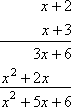
And, as mentioned above, we can always check our work by multiplying our factors back together, and check that we have gotten back to the original answer. To check the above factorization, the multiplication goes like this:
What is factoring by grouping?
Your text or teacher may refer to factoring "by grouping", which is covered here on Purplemath in the lesson on simple factoring. In the "easy" case of factoring, using the "grouping" method just gives you some extra work. For instance, in the above problem, in addition to finding the factors of +6 that add to +5, you would have had to do these additional steps:
x2 + 5x + 6
x2 + 3x + 2x + 6
(x2 + 3x) + (2x + 6)
x(x + 3) + 2(x + 3)
(x + 3)(x + 2)
You would get the same answer as above, but (in my experience) it's easier to just go straight to filling in the parentheses. And this method is much less prone to errors than is the by-grouping method.
- Factor x2 + 7x + 6
The leading term is just 1, so this is the simple case of factoring. The constant term is 6, which can be written as the product of 2 and 3 or of 1 and 6, just as in the previous exercise. But the coefficient on the middle term is different this time. Instead of a +5, I've got a +7.
The sign on the constant term is the same as before (namely, a "plus"), so I'll still need to "plus" factors. But the sum (that is, the middle-term's coefficient) is different; it's now a 7. Whereas 2 + 3 = 5 worked for the previous quadratic, +2 and +3 are not the numbers I need in this case. On the other hand, 1 + 6 = +7, so I'll use +1 and +6 for this factorization. And I'll also go straight from having drawn this conclusion to writing down my final answer:
(x + 1)(x + 6)
Again, remember that the order doesn't matter in multiplication, so the above answer could equally-correctly be written as "(x + 6)(x + 1)".
- Factor x2 − 5x + 6
The constant term (created by the multiplication of the constants in the two original binomials) is +6, so my factors will either both be "plus" or else both be "minus". But the middle coefficient this time is "minus". Since I'm adding to a "minus", (namely, to −5), then both factors must be "minus".
When the middle term's coefficient had been a "plus" five, I'd used factors +2 and +3. Now that my middle term's coefficient is "minus", I will use −2 and −3:
(x − 2)(x − 3)
Note that we can use clues from the signs to determine which pairs of factors to use, as I demonstrated in the previous exercises. The rules, formally, look like this:
Rules for Finding the Factors for a Simple Quadratic
When you're factoring a quadratic of the form x2 + bx + c (that is, where the leading coefficient on x2 is just 1), following these steps:
- If c is "plus", then the factors will be either both "plus" or else both "minus".
- If b is "plus", then the factors are both "plus".
- If b is "minus", then the factors are both "minus".
- In either case, look for factors that add to b.
- If c is "minus", then the factors will be of alternating signs; that is, one will be "plus" and one will be "minus".
- If b is "plus", then the larger of the two factors is "plus".
- If b is "minus", then the larger of the two factors is "minus".
- In either case, look for factors that subtract to b; that is, look for factors which are b units apart.
- Factor x2 − 7x + 6
The leading coeficient is 1, so this is a simple-factoring quadratic. I am multiplying to a "plus" six, so the factors will be either both "plus" or else both "minus". Looking at the middle term, I see that I am adding to a "minus" seven, so my factors will both be "minus".
The (negative) factors of +6 that add up to 7 are −1 and −6, so I will use −1 and −6 for my factorization:
(x − 1)(x − 6)
So far, c (the constant term) has always been a "plus". What if c is a "minus"?
- Factor x2 + x − 6
Since I am multiplying to a "minus" six, I need factors that have opposite signs; that is, one factor will be "plus" and the other will be "minus". The coefficient on the middle term is a "plus" 1, so I know that the larger of the two factors (larger, that is, in terms of its absolute value) will get the "plus" sign. Since these opposite-signed numbers will be added together to get +1, then I need the two factors to be one unit apart.
The factor pairs for 6 are 1 and 6, and 2 and 3. The values in the second pair are one unit apart, so I know that I will be using 2 and 3.
Because I need to get a "plus" answer for the sum of the two factors, I'll need the larger of my two numbers to get the "plus" sign; namely, the 3 will be getting the "plus" sign (so the 2 gets the "minus" sign). Then my factorization is:
(x − 2)(x + 3)
- Factor x2 − x − 6
This looks just like the previous quadratic, except that now the middle term is "minus". The constant term is still "minus", so I still want factors with opposite signs. And the middle term's coefficient (other than its sign) is still 1, so I still want factors that are one unit apart. But this time the larger factor will get the "minus" sign.
All the other considerations remain the same. I still want factors of 6 that are one unit apart, so I'll still be using 2 and 3. But this time, the sign on the 3 will be a "minus":
(x − 3)(x + 2)
- Factor x2 − 5x − 6
In this quadratic, the constant term is "minus", so I still want factors of opposite signs.
However, this time, the middle term's coefficient (other than its sign) is 5 rather than 1, so now I want my two factors to be five units apart. And because the middle term's coefficient is "minus", the larger of my two factors will get the "minus" sign.
The factor pairs for 6 are 1 and 6, and 2 and 3. The numbers in the first pair of factors are five apart, so I'll be using the numbers 1 and 6. I'm adding to a "minus", so I'll give the larger of my factors the "minus" sign; that is, I'll be using +1 and −6 for this factorization:
(x − 6)(x + 1)
There is one special case, by the way, for factoring quadratics. Back when you were factoring plain old numbers, there were some numbers that didn't factor, such as 5 or 13. Recall that these unfactorable numbers are called "prime" numbers. You could always multiply two whole numbers to get another whole number, but some whole numbers could not be divided to get two (non-trivial) whole numbers.
Similarly, there are quadratics that won't factor. You can multiply two binomials (without fractions) to get a quadratic (without fractions), but not all quadratics can be factored to get two (non-trivial) binomials. The terminology for such quadratics (or any un-factorable polynomial) is also "prime".
What is an example of trying to factor a prime quadratic?
- Factor x2 + 7x − 6
The leading coefficient is 1, so this is a case of simple factoring. Since the constant term is "minus", I'll be needing a "plus" factor and a "minus" such that, when I multiply them together, I get −6, but when I add them, I get +7. In other words, I'll need two factors that are seven units apart, with the larger factor getting the "plus" sign.
The factor pairs for 6 are 1 and 6, and 2 and 3. At first glance, I may assume that I should use 1 and 6, but —
While +1 and +6 do add to +7, I know that one of the factors has to be "minus" in order to multiply to get a −6; the factors cannot both be positive. Trying the first factor pair of 1 and 6, the sum would be one of the following:
(−1) + 6 = 5
1 + (−6) = −5
Okay; neither way worked. So maybe I should be using the other factor pair…? Checking the addition with those numbers, I get:
(−2) + 3 = 1
2 + (−3) = −1
One might think, "Well, maybe I should should do the signs differently." But the only way to get factors of 6 to add up to 7 is to give those factors the same sign. But if I do that, then the factors won't multiply to a −6.
In other words, there is no pair of factors of −6 that will add to +7. And if something isn't factorable, then it's prime. So x2 + 7x − 6 is a prime quadratic polynomial. In technical terms, it is "unfactorable over the integers", so-called because I couldn't find a pair of integers that would work. Then my answer is:
unfactorable: prime
© 2024 Purplemath, Inc. All right reserved. Web Design by 