



Intro to the Rational Roots Test
Purplemath
What is a zero or root of a polynomial?
The zero of a polynomial is an input value (usually an x-value) that returns a value of zero for the whole polynomial when you plug it into the polynomial. When a zero is a real (that is, when the zero is not a complex) number, it is also an x-intercept of the graph of the polynomial function.

You will frequently (especially in calculus) want to know the location of the zeroes of a given polynomial function. You could plug numbers into the polynomial, willy-nilly, and hope for the best. But as you learned when you studied the Quadratic Formula, zeroes are often very messy numbers; randomly guessing is probably not the best plan of attack. So how does one go about trying to find zeroes?
What is the Rational Roots Test?
The Rational Roots Test (or Rational Zeroes Theorem) is a handy way of obtaining a list of useful first guesses when you are trying to find the zeroes (or roots) of a polynomial. Given a polynomial with integer (that is, positive and negative whole-number) coefficients, the *possible* zeroes are found by listing the factors of the constant (last) term over the factors of the leading coefficient, thus forming a list of fractions. This listing gives you a list of *potential* rational (that is, integer and fractional) roots to try — hence the name of the Test.
Will the Rational Roots Test give me roots for my polynomial?
Let me emphasize: The Rational Roots Test does *not* give you the zeroes of your polynomial. It does not say what the zeroes definitely will be. The Test only gives you a list of relatively easy, nice, and neat numbers to try in the polynomial. Most of these possible zeroes will turn out not actually to be zeroes.
How does the Rational Roots Test work?
You can see the sense of the Test's methodology by looking at a simple quadratic polynomial and considering its zeroes:
12x2 − 7x − 10
You can use the Quadratic Formula to find the zeroes, but you can also factor the quadratic to get:
12x2 − 7x − 10
= (3x + 2)(4x − 5)
Setting the two factors equal to zero, you get the two roots:
Note that the denominators of these two roots are 3 and 4 are factors of the leading coefficiant 12, and the numerators 2 and 5 are factors of the constant term 10. That is, the zeroes of this quadratic are fractions formed of factors of the constant term 10 over factors of the leading coefficient 12.
So the Rational Roots Test would have given us all the zeroes? No way! Most of the so-called zeroes it would spit out would not, in actual fact, be true zeroes. (A quadratic, being a degree-two polynomial, can have no more than two roots; the Rational Roots Test, in this case, spits out nine possibilities.) In particular, note that fractions such as and can also be formed this way (and would thus be provided to you by the Test), but these other fractions are not in fact zeroes of this quadratic.
So what does the Rational Roots Test actually mean?
The Rational Roots Tests means no more and no less than this: If a polynomial has any rational roots (and it might not), then those roots will be fractions of the form (plus-or-minus) (factor of the constant term) / (factor of the leading coefficient).
However, not all fractions of this form are necessarily zeroes of the polynomial. Indeed, it may happen that none of the fractions produced by the Test is actually a zero of the polynomial.
Note that I keep saying "potential" roots, "possible" zeroes, "if there are any such roots...". This is because the list of fractions generated by the Rational Roots Test is just a list of potential solutions. It need not be true that any of the fractions is actually a solution: there might not be any fractional roots! For example, given x2 − 2, the Rational Roots Tests gives the following possible rational zeroes:

But you already know that the actual zeroes are irrational, being square roots of a prime number:

...so, while the Rational Roots Test does spit out *possible* integer zeroes, it turns out that the zeroes aren't actually rational at all.
Always remember: The Rational Roots Test only gives a list of good first guesses; it does NOT give you all (or maybe even any) of the answers!
- Find all possible rational x-intercepts of x4 + 2x3 − 7x2 − 8x + 12.
The constant term is 12, with factors of 1, 2, 3, 4, 6, and 12. The leading coefficient in this case is just 1, which makes my work a lot simpler. The Rational Roots Test says that the possible zeroes are at:

So my possible, might-have-some-potential, maybe-a-good-place-to-check-first list is:
−12, −6, −4, −3, −2, −1, 1, 2, 3, 4, 6, 12

What is the Rational Roots Test really for?
The Rational Roots Test is usually used to try to find the x-intercepts of a polynomial graph. So you won't usually be stopping with a list. You'll be continuing on to factor, or find all the zeroes, or graph, or all three.
This is where you can do a quick graph (especially if you have a graphing calculator), and see which of the list's value look good to try. For instance, comparing the graph below with the list above, you would probably do well to start looking for zeroes by plugging the values x = −3, −2, 1, and 2 into the polynomial.
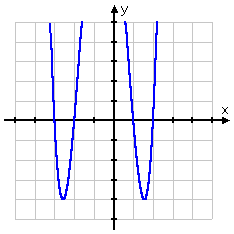
Yes, this is a bit backwards — looking at the graph to figure out how to do the graph — but it's also a helpful way to cut the time spent on this sort of exercise, especially on a timed test. Don't spend precious minutes trying every possible fraction, when the graph can tell you the exact one to try.
© 2024 Purplemath, Inc. All right reserved. Web Design by 