



How to Subtract Rational Expressions
Purplemath
Subtracting rational expressions works just like adding rational expressions. The only real difference is when you're combining the numerators. Because you're subtracting one numerator from the other, you may want to put parentheses around the subtracted numerator. By doing so, you'll remember to take that "minus" through on everything that's being subtracted.

How do you subtract rational expressions?
- Find the lowest common denominator for the assorted polynomial fractions.
- Convert each of the rational expressions to this common denominator.
- Subtract the numerators, being careful to take the "minus" all the way through the subtracted numerator.
- Simplify, if possible. (It usually won't be.)
As you follow along in the worked examples below, note how I do everything neatly and orderly. You should aim to model your work after these exercises, to help minimize errors in your homework and to help maximize points on the exam.
- Simplify the following:
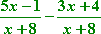
These fractions already have a common denominator, so I can go straight to combining them. But I'll use parentheses on the numerators, to make sure I carry the "minus" through the second parentheses. (A common mistake would be to take the "minus" sign only onto the 3x and not also onto the 4.)

Nothing simplifies or cancels. (No, the x's do not cancel off, nor does the 2 cancel off with the 8. Why not? Because only factors cancel, not terms or mere parts of factors. I can't reach inside the understood parentheses around each of the 2x − 5 and the x + 8. I can't go hacking and whacking things from inside parentheses — ever!)
So my hand-in answer is:

It isn't common that you will be able to simplify a rational addition or subtraction problem, but you should get in the habit of checking. I would bet good money that you'll have a problem that simplifies on the next test.
- Simplify the following:

Again, these already have a common denominator, so I can just combine them as they are. But the denominator is a quadratic, so I'll want to factor the numerator when I'm done, to check and see if anything cancels out.
![3x/(x^2 + 3x - 10) - 6/(x^2 + 3x - 10) = [3(x - 2)]/[(x + 5)(x - 2)] = 3/(x + 5)](rational/add12.png)
As you can see, something did cancel this time. I always need to remember this step: factor the denominator and numerator (if possible) and check for common factors.
By the way, since I was able to cancel off the x − 2 factor, this eliminated a zero from the denominator. Depending on your book and on your instructor, you may (or may not) need to account for this change in the domain of the fraction.
I try always to remember to include any possible changes to the domain, so my complete answer is:

Depending on your instructor, you might not need the "for x ≠ 2" part. If you're not sure, ask now, before the test.
- Simplify the following:

First I have to convert these fractions to the common denominator of 2x2. (If you're not sure about the common denominator, do the factor table, as shown in the second example on the previous page, to check.) Then I'll add and, if possible, cancel off common factors.

Note how I used parentheses to keep my subtraction straight. I wanted to be sure to carry the "minus" through properly, and the extra step with the parentheses is very helpful for this. Nothing cancellsin this case (because neither 2 nor x factors out of the numerator), so my answer is:


- Simplify the following:

The two denominators have no common factors, so the common denominator will be (2x − 1)(x − 6).
![4x/(2x - 1) - 5/(x - 6) = (4x^2 - 34x + 5)/[(2x - 1)(x - 6)]](rational/add18.png)
The numerator doesn't factor, so there is no chance of anything cancelling off. It is customary to leave the denominator factored like this, so, unless your instructor says otherwise, don't bother multiplying the denominator out.
So my hand-in answer is:
![(4x^2 - 34x + 5)/[(2x - 1)(x - 6)]](rational/add22.gif)
Can you combine a rational exprression and a whole number?
You can combine rational expressions with whole numbers; just keep in mind that the denominator of every integer is 1. (You can also combine rational expressions with strictly numerical fractions.)
- Simplify the following:

I shouldn't let this one throw me. The denominator of the 2 is just 1, so the common denominator will be the only other denominator of interest: x + 2.

Nothing cancels, so my answer is:

© 2024 Purplemath, Inc. All right reserved. Web Design by 