


Using Clues to Find Trig Ratios
Purplemath
Originally, you learned about trig ratios in the context of right triangles, where the measure of the base angle was between 0° and 90°. In this lesson, we've expanded the trig ratios to being findable for angles with measures between 90° and 360°.
Keep in mind that any angle outside of this range can be converted to this range by subtracting multiples of 360° until the angle is within this range.

For instance, if you were given an angle measuring 475°, you'd reduce this by subtracting 360° to get an equivalent angle measure of 115°.
- Find the values of the remaining trigometric ratios if
![tan(alpha) = sqrt[7] / 3](trig/quadan18.gif) and sin(α) < 0.
and sin(α) < 0.
The tangent is positive in QI and in QIII. The sine ratio is negative in QIII and QIV. The overlap is QIII, so α must terminate in the third quadrant.
In the third quadrant, each of x and y is negative, so the numerator and denominator of the tangent ratio y/x are both negative.
I'll draw what I've got so far:
![axes drawn, terminal side of α in QIII, height y = -sqrt[7] drawn below the x-axis, base x = -3 drawn to the left of the origin](trig/quadan19.gif)
The Pythagorean Theorem gives me:
![(sqrt[7])^2 + 3^2 = 7 + 9 = 16 = r^2, so r = +/- 4](trig/quadan21.gif)
The hypotenuse r is always positive, so r = +4 and now my picture becomes:
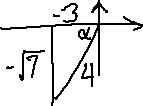
This picture contains all the information that I need in order to find the other ratios. So those other ratios have the following values:
![sin(alpha) = -sqrt[7]/4, cos(alpha) = -3/4](trig/quadan22.png)
![csc(alpha) = -4/sqrt[7], sec(alpha) = -4/3, cot(alpha) = -3/sqrt[7]](trig/quadan22a.png)
The values for the cosecant and cotangent ratios can be expressed in either of two ways, depending on whether your particular text book still cares whether you leave radicals in the denominator. (I've rationalized the denominators in my values, above, for these two ratios.)
Your calculus book probably won't care about rationalizing; your algebra book definitely did care; trig books vary. If you're not sure what is the protocol for your class, ask your instructor now, before the next test.
- The equation 5x + 3y = 0, with the restriction that x ≤ 0, is the equation of the terminal side of an angle α. Find the values of the six trigonometric ratios for this angle.
This is an unusual sort of exercise, but I can use what I've learned in algebra to pick it apart.
First, I'll solve for "y=" to get the equation of the line:
From what I remember of graphing, I know that this is an decreasing line through the origin, so it passes through QII and QIV. Since they gave me the restriction that x is negative, then the angle alpha must end in QII.
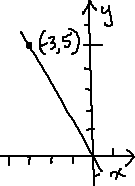
To get a point on this line, I'll plug −3 for x, so I get 5 for y (and whole-number coordinates for easy graphing and computation).
So I've got this much so far:
Dropping the perpendicular to create the right triangle, I can label the side lengths from the point, and also label the angle, to get:
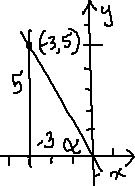
The height is y = 5 and the base is x = −3, so the hypotenuse is given by:
![+/- sqrt[34] = r](trig/quadan27.gif)

Since r is always positive, then the hypotenuse takes the positive value, ![r = sqrt[34]](trig/quadan28.gif) , and my triangle is:
, and my triangle is:
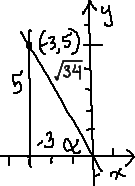
Then the six trig ratios are:
![sin(alpha) = 5/sqrt[34], cos(alpha) = -3/sqrt[34], tan(alpha) = -5/3](trig/quadan26.png)
![csc(alpha) = sqrt[34]/5, sec(alpha) = -sqrt[34]/3, cot(alpha) = -3/5](trig/quadan26a.png)
© 2024 Purplemath, Inc. All right reserved. Web Design by 