



Parabola Word Problems & Graphing Calculators
Purplemath
What are some examples of parabolas in real life?
Because parabolas, by definition, collect information (signals, etc) at their foci, then they are useful in real life to things that collect signals. For instance, radio-antenna dishes are parabolic, as are parts of headlights and the parabolic dishes of lighthouses.

Also, "ballistic motion" is modelled by an arc based on parabolas.
What are some examples of things in real life that are *not* parabolas?
Many things are claimed to be in the shape of a parabola, but are not, such as:
- A chain hanging freely hanging between two attachment points forms a curve called a catenary; a hanging chain (or rope) does not form a parabola.
- The St. Louis Arch is an upside-down catenary; it is not a parabola.
- Some part of some bananas *might* match a parabola, but not in general.
- Some parts of some bridges and roller coasters *might* match parabolas, but not in general.
- A Slinky toy does not form a parabola.
- A rainbow does not form a parabola; a rainbow is actually part of a circle.
Despite the ease of determining that rainbows, the St. Louis Arch, etc, are *not* parabolas, you should still expect to see some word problems that kind of assume that these things *are* parabolas. Just roll with it.
- An arch in a memorial park, having a parabolic shape, has a height of 25 feet and a base width of 30 feet. Find an equation which models this shape, using the x-axis to represent the ground. State the focus and directrix.
For simplicity, I'll center the curve for the arch on the y-axis, so the vertex will be at:
(h, k) = (0, 25)
Since the width is thirty, then the x-intercepts must be at:
x = −15
x = +15
Obviously, this is a regular (vertical) parabola, but it's upside-down so the x part is squared and I'll have a negative leading coefficient.
Working backwards from the x-intercepts, the equation has to be of the form:
y = a(x − 15)(x + 15)
Plugging in the known vertex value, I get:
(25) = a((0) − 15)((0) + 15) = −225a
25 = −225a
−(1/9) = a
With a being the leading coefficient from the regular quadratic equation y = ax2 + bx + c, I also know that the value of 1/a is the same as the value of 4p, so:
1/(−1/9) = −9 = 4p
p = −9/4
Then my line equation is:
4p(y − k) = (x − h)2
4(−9/4)(y − 25) = (x − 0)2
−9(y − 25) = x2
I placed the vertex at the point (0, 0). The focus is 9/4 units below the vertex; the directrix is the horizontal line 9/4 units above the vertex. Therefore, my answer is:
equation: −9(y − 25) = x2
focus: (0, 91/4)
directrix: y = 109/4
Note: In the above exercise, I could also have worked directly from the conics form of the parabola equation, plugging in the vertex and an x-intercept, to find the value of p. This method would work as follows:
4p(y − 25) = (x − 0)2
4p(0 − 25) = (15 − 0)2
4p(−25) = 225
4p = −225/25 = −9
p = −9/4
You may encounter an exercise of this sort regarding the Gateway Arch in Saint Louis, Missouri, which is, in fact, an inverted catenary curve; in particular, a hyperbolic cosine curve. But its shape is close enough to that of a parabola for the purposes of the exercise.
(If you ever visit Saint Louis, you should definitely try to visit the Arch. You can watch a movie down in the basement describing the design and construction of the Arch, and then you ride the tram up to the top of the Arch. The view is fabulous!)

- A radio telescope has a parabolic dish with a diameter of 100 meters. The collected radio signals are reflected to one collection point, called the focal point, being the focus of the parabola. If the focal length is 45 meters, find the depth of the dish, rounded to one decimal place.
To simplify my computations, I'll put the vertex of my parabola (that is, the base of the dish) at the origin, so:
(h, k) = (0, 0)
The focal length is the distance between the vertex and the focus. Since the focal length is 45, then p = 45 and the equation is:
4py = x2
4(45)y = x2
180y = x2
This parabola extends forever in either direction, but I only care about the part of the curve that models the dish. Since the dish has a diameter of a hundred meters, then I only care about the part of the curve from x = −50 to x = +50.
The height of the edge of the dish (and thus the depth of the dish) will be the y-value of the equation at the "ends" of the modelling curve. The height of the parabola will be the same at either x-value, since they're each the same distance from the vertex, so it doesn't matter which value I use. I prefer positive values, so I'll plug x = 50 into my modelling equation:
180y = (50)2
180y = 2500
y = 250/18 = 125/9
Plugging into my calculator and rounding to one decimal place (per instructions), my answer is:
depth: 13.9 meters
If you need to graph a sideways parabola in your graphing calculator (to check your work, for instance), you'll need to solve the equation for its two halves, and then graph the two halves as two separate functions. For instance, to view the graph of:
(y + 2)2 = −4(x − 1)
...you'd solve and graph as:
![(y + 2)^2 = -4(x - 1), y + 2 = +/- sqrt[-4(x - 1)], y = -2 +/- sqrt[-4(x - 1)]](conics/parab10.gif)
Enter the "plus" and "minus" parts into your calculator as separate functions:
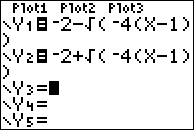
The calculator's graph will likely show a slight gap between the two halves of the parabola:
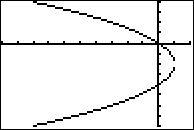
Don't expect the two halves of the graph to "meet in the middle" on your calculator screen; that's a higher degree of accuracy (and comprehension) than the calculator can handle.
In my experience, it is easier to remember the relationships between the vertex, focus, axis of symmetry, directrix, and the value of p, than to try to memorize the (often very long) list of formulas they give you. Do enough practice exercises that you have a good grasp of how these elements are related, and you should be successful with parabolas.
© 2024 Purplemath, Inc. All right reserved. Web Design by 