



Proving that Two Functions are Inverses of Each Other
Purplemath
So far, we have seen how to draw an inverse if you're given the graph, and how to find an inverse if you're given the formula for the original function, including how to find the proper restrictions (if needed) on domains and ranges.
But suppose you are given two functions and told to verify (that is, told to check for yourself) that they are inverses of each other. How would you do that?
First, you would need to note that drawing the graphs is not a valid mathematical proof. To emphasize that a picture isn't proof, the instructions will often tell you to "verify algebraically" that the functions are inverses. What does that look like?
If you think back to the definition of an inverse, the point of the inverse is that it's backwards from what you started with; it takes you back to where you started from. For instance, if the point (1, 3) is on the graph of the function, then the point (3, 1) is on the graph of the inverse. That is, if you start with x = 1, you will go to y = 3; then you plug this into the inverse, and you'll go right back to x = 1, where you started from. It is this property that you use to prove (or disprove) that functions are inverses of each other.
How to you prove algebraically that two functions are inverses of each other?
To prove (or disprove) that two functions are inverses of each other, you compose the functions (that is, you plug x into one function, plug that function into the proposed inverse function, and then simplify) and verify that you end up with just "x". If you end up with x (that is, if you end up with what you'd started with), then the functions are inverses; otherwise, they are not.
- Determine algebraically whether f (x) = 3x − 2 and are inverses of each other.
I will plug the formula for g(x) into every instance of "x" in the formula for f (x):
![f(g(x)) = f[(x+2)/3] = 3{[x+2]/3} - 2 = [x + 2] - 2 = x](inverse/invers84.gif)
Okay; the composition worked in the one way. Now I'll go the other way; that is, I will plug the formula for f (x) into every instance of "x" in the formula for g(x):
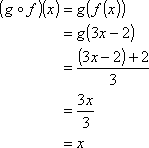
Both ways composing the functions, I ended up with just "x", so:
Yes, f (x) and g(x) are inverses of each other
- Determine algebraically whether f (x) = 3x − 2 and are inverses of each other.
I'll plug the formula for g(x) into every instance of x in the formula for f (x):
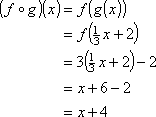
I didn't end up with just "x", so:
f (x) and g(x) are not inverses of each other.
Once you've found one composition that doesn't work, you're done. You don't have to show that the composition doesn't work the other way, either.
A close examination of this last example above points out something that can cause problems for some students. Since the inverse "undoes" whatever the original function did to x, the instinct is to create an inverse by applying reverse operations. In this case, the function f (x) multiplied x by 3 and then subtracted 2 from the result. So the instinct is to think that the inverse would be to divide x by 3 and then to add 2 to the result.

But as you saw above, this is not correct. Comparing this example (where the functions were not inverses) with the example at the beginning of the page (where the functions *were* inverses), you can see that the reversed operations were correct, but that they also need to be applied in reverse order. That is, since f (x) first multiplied x by 3 and then subtracted off 2, the inverse first adds the 2 back on, and then divides the 3 back off.
Also, in the second example, as soon as I did not end up with x, I knew the functions were not inverses. I had done the composition (f ∘ g)(x) and had come up with something other than x, so I didn't bother checking (g ∘ f )(x). In the first example, however, I checked (f ∘ g)(x) and came up with x, and then I also checked (g ∘ f )(x), too. Why? Here's an example of why:
- Determine algebraically whether f (x) = x2 and
 are inverses of each other.
I know that a parabola will not pass the Horizontal Line Test, so f (x), lacking any domain restrictions, is not invertible, so g(x) cannot be its inverse. But I still need to show the algebra.
First, I'll plug g(x) into f (x):
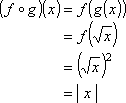
Since I started by plugging x into g(x), then I started with non-negative x-values. Since the absolute value of zero is zero and the absolute value of a positive number is just itself, then, in this case, I can simplify | x | as just x. Then I have (f ∘ g)(x) = x.
(Where did the absolute-value bars come from? The square root of something squared is the technical definition of the absolute value: the square of the value will always be positive, as will the square root, so taking the square root of something squared always returns the positive of the original number. In this case, the domain of g(x) was defined as non-negative, so the absolute-value bars could be dropped above. But this isn't always the case.)
Looking good so far: I've determined that (f ∘ g)(x) = x. Now I'll go the other way, and plug f (x) into g(x):
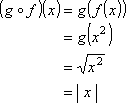
Hmm... Since I started by plugging x into f (x), then I was starting with *any* value of x. In particular, the value of x might have been negative. Since I don't know if x is negative or positive, then I can't remove the absolute-value bars on the final answer, and I'm stuck with an answer of (g ∘ f )(x) = | x |. So (g ∘ f )(x) does not simplify to being just x.
Then my answer is:
g(x) and f (x) are not inverses of each other.
This is why you need to check both ways: sometimes there are fussy technical considerations, usually involving square roots, that force the composition not to work, because the domains and ranges of the two functions aren't compatible. In this case, if f (x) had been restricted to non-negative x-values, then the functions would have been inverses.
In general, though, if one composition gives you just x, then the other one will, too, especially if you're not dealing with restricted domains. But you should remember to do both compositions on tests and such, both to be sure of your answer and also to get full credit.
How can you tell if functions are inverses from a table or T-chart?
Unless the two functions are just small sets of points, you can't tell from a table or T-chart whether or not they are inverses of each other. But in the special case where the functions are just small sets of points:
- Count the number of points in each function's set; the sets must contain the same number of points.
- Compare the points; for every point (a, b) in the one function's set of points, there *must* be the point (b, a) in the other function's set of points.
If the sets don't have the same number of points, or if there is a point in one set that doesn't have a coordinate-reversed corresponding point in the other set, then the functions are not inverses.
© 2024 Purplemath, Inc. All right reserved. Web Design by 