


Geometric Series
Purplemath
You can take the sum of a finite number of terms of a geometric sequence. And, for reasons you'll study in calculus, you can take the sum of an infinite geometric sequence, but only in the special circumstance that the common ratio r is between –1 and 1; that is, you have to have | r | < 1.
For a geometric sequence with first term a1 = a and common ratio r, the sum of the first n terms is given by:
![sum, from i = 1 to n, of a-sub-i is equal to (a) [ (1 − r^n) / (1 − r) ]](series/sum19.gif)

Note: Your book may have a slightly different form of the partial-sum formula above. For instance, the "a" may be multiplied through the numerator, the factors in the fraction might be reversed, or the summation may start at i = 0 and have a power of n + 1 on the numerator. All of these forms are equivalent, and the formulation above may be derived from polynomial long division.
In the special case that | r | < 1, the infinite sum exists and has the following value:

-
Evaluate the following:
![sum, from i = 1 to 20, of [3(−2)^i]](series/sum21.gif)
The first few terms are −6, 12, −24:
a1 = 3(−2)1 = (3)(−2) = −6
a2 = 3(−2)2 = (3)(4) = 12
a3 = 3(−2)3 = (3)(−8) = −24
So this is a geometric series with common ratio r = −2. (I can also tell that this must be a geometric series because of the form given for each term: as the index increases, each term will be multiplied by an additional factor of −2.)
The first term of the sequence is a = −6. Plugging into the summation formula, I get:
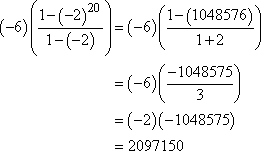
So the value of the summation is:
2,097,150
-
Evaluate S10 for 250, 100, 40, 16,....
The notation "S10" means that I need to find the sum of the first ten terms. The first term is a = 250. Dividing pairs of terms, I get:
...and so forth, so the terms being added form a geometric sequence with common ratio .
Unlike the formula for the n-th partial sum of an arithmetic series, I don't need the value of the last term when finding the n-th partial sum of a geometric series. So I have everything I need to proceed. When I plug in the values of the first term and the common ratio, the summation formula gives me:

I will not "simplify" this to get the decimal form, because that would almost-certainly be counted as a "wrong" answer. Instead, my answer is:

Note: If you try to do the above computations in your calculator, it may very well return the decimal approximation of 416.62297... instead of the fractional (and exact) answer.

As you can see in the screen-capture above, entering the values in fractional form and using the "convert to fraction" command still results in just a decimal approximation to the answer. But (really!) the decimal approximation will almost certain be regarded as a "wrong" answer. Take the time to find the fractional form.
-
Find an if and .
They've given me the sum of the first four terms, S4, and the value of the common ratio r. Since there is a common ratio, I know this must be a geometric series. Plugging into the geometric-series-sum formula, I get:
![S_4 = a[(1 − r^4)/(1 − r)], so 26/27 = a(40/27)](series/sum26.gif)
Multiplying on both sides by to solve for the first term a = a1, I get:

Then, plugging into the formula for the n-th term of a geometric sequence, I get:

-
Show, by use of a geometric series, that 0.3333... is equal to .
There's a trick to this. I first have to break the repeating decimal into separate terms; that is, "0.3333..." becomes:
0.3 + 0.03 + 0.003 + 0.0003 + ...
Splitting up the decimal form in this way highlights the repeating pattern of the non-terminating (that is, the never-ending) decimal explicitly: For each term, I have a decimal point, followed by a steadily-increasing number of zeroes, and then ending with a "3". This expanded-decimal form can be written in fractional form, and then converted into geometric-series form:
![0.333... = 3/10 + 3/100 + 3/1000 + ... = sum [ (3/10) (1/10)^(n−1) ]](series/sum29.gif)
This proves that 0.333... is (or, at least, can be expressed as) an infinite geometric series with and . Since | r | < 1, I can use the formula for summing infinite geometric series:
![0.333... = (3/10) [1/(1 − (1/10))] = (3/10)(10/9) = 3/9 = 1/3](series/sum30.gif)
For the above proof, using the summation formula to show that the geometric series "expansion" of 0.333... has a value of one-third is the "showing" that the exercise asked for (so it's fairly important to do your work neatly and logically). And you can use this method to convert any repeating decimal to its fractional form.
-
By use of a geometric series, convert 1.363636... to fractional form.
First I'll break this into its constituent parts, so I can find the pattern:
1.363636.. = 1 + 0.36 + 0.0036 + 0.000036 + ...
There are two digits that repeat, so the fractions are a little bit different. But this is still a geometric series:
![1.363636... = 1 + 0.36 + 0.0036 + ... = 1 + sum [(9/25)(1/100)^(n−1)]](series/sum31.gif)
This shows that the original decimal can be expressed as the leading "1" added to a geometric series having and . Because the value of the common ratio is sufficiently small, I can apply the formula for infinite geometric series. Then the sum evaluates as:

So the equivalent fraction, in improper-fraction form and in mixed-number form, is:
By the way, this technique can also be used to prove that 0.999... = 1.
© 2024 Purplemath, Inc. All right reserved. Web Design by 