



Arithmetic & Geometric Sequences
Purplemath
The two simplest sequences to work with are arithmetic and geometric sequences.
An arithmetic sequence goes from one term to the next by always adding (or subtracting) the same value. For instance, 2, 5, 8, 11, 14,... is arithmetic, because each step adds three; and 7, 3, −1, −5,... is arithmetic, because each step subtracts 4.
The number added (or subtracted) at each stage of an arithmetic sequence is called the "common difference" d, because if you subtract (that is, if you find the difference of) successive terms, you'll always get this common value.

A geometric sequence goes from one term to the next by always multiplying (or dividing) by the same value. So 1, 2, 4, 8, 16,... is geometric, because each step multiplies by two; and 81, 27, 9, 3, 1, ,... is geometric, because each step divides by 3.
The number multiplied (or divided) at each stage of a geometric sequence is called the "common ratio" r, because if you divide (that is, if you find the ratio of) successive terms, you'll always get this common value.
-
Find the common difference and the next term of the following sequence:
3, 11, 19, 27, 35, ...
To find the common difference, I have to subtract a successive pair of terms. It doesn't matter which pair I pick, as long as they're right next to each other. To be thorough, I'll do all the subtractions:
11 − 3 = 8
19 − 11 = 8
27 − 19 = 8
35 − 27 = 8
The difference is always 8, so the common difference is d = 8.
They gave me five terms, so the sixth term of the sequence is going to be the very next term. I find the next term by adding the common difference to the fifth term:
35 + 8 = 43
Then my answer is:
common difference: d = 8
sixth term: 43
-
Find the common ratio and the seventh term of the following sequence:
To find the common ratio, I have to divide a successive pair of terms. It doesn't matter which pair I pick, as long as they're right next to each other. To be thorough, I'll do all the divisions:
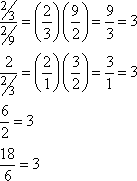
The ratio is always 3, so r = 3.
They gave me five terms, so the sixth term is the very next term; the seventh will be the term after that. To find the value of the seventh term, I'll multiply the fifth term by the common ratio twice:
a6 = (18)(3) = 54
a7 = (54)(3) = 162
Then my answer is:
common ratio: r = 3
seventh term: 162
Since arithmetic and geometric sequences are so nice and regular, they have formulas.
For arithmetic sequences, the common difference is d, and the first term a1 is often referred to simply as "a". Since we get the next term by adding the common difference, the value of a2 is just:
a2 = a + d
Continuing, the third term is:
a3 = (a + d) + d = a + 2d
The fourth term is:
a4 = (a + 2d) + d = a + 3d
At each stage, the common difference was multiplied by a value that was one less than the index. Following this pattern, the n-th term an will have the form:
an = a + (n − 1)d
For geometric sequences, the common ratio is r, and the first term a1 is often referred to simply as "a". Since we get the next term by multiplying by the common ratio, the value of a2 is just:
a2 = ar
Continuing, the third term is:
a3 = r(ar) = ar2
The fourth term is:
a4 = r(ar2) = ar3
At each stage, the common ratio was raised to a power that was one less than the index. Following this pattern, the n-th term an will have the form:
an = ar(n − 1)
Memorize these n-th-term formulas before the next test.
-
Find the tenth term and the n-th term of the following sequence:
, 1, 2, 4, 8,...
The first thing I have to do is figure out which type of sequence this is: arithmetic or geometric. I quickly see that the differences don't match; for instance, the difference of the second and first term is 2 − 1 = 1, but the difference of the third and second terms is 4 − 2 = 2. So this isn't an arithmetic sequence.
On the other hand, the ratios of successive terms are the same:
2 ÷ 1 = 2
4 ÷ 2 = 2
8 ÷ 4 = 2
(I didn't do the division with the first term, because that involved fractions and I'm lazy. The division would have given the exact same result, though.)
So clearly this is a geometric sequence with common ratio r = 2, and the first term is a = . To find the n-th term, I can just plug into the formula an = ar(n − 1):
To find the value of the tenth term, I can plug n = 10 into the n-th term formula and simplify:
Then my answer is:
n-th term:
tenth term: 256
-
Find the n-th term and the first three terms of the arithmetic sequence having a6 = 5 and d =
The n-th term of an arithmetic sequence is of the form an = a + (n − 1)d. In this case, that formula gives me . Solving this formula for the value of the first term of the sequence, I get a = . Then:
a1 =
a2 = = −1
a3 =
This gives me the first three terms in the sequence. Since I have the value of the first term and the common difference, I can also create the expression for the n-th term, and simplify:
Then my answer is:
n-th term:
first three terms:
-
Find the n-th term and the first three terms of the arithmetic sequence having a4 = 93 and a8 = 65.
Since a4 and a8 are four places apart, then I know from the definition of an arithmetic sequence that I'd get from the fourth term to the eighth term by adding the common difference four times to the fourth term; in other words, the definition tells me that a8 = a4 + 4d. Using this, I can then solve for the common difference d:
65 = 93 + 4d
−28 = 4d
−7 = d
Also, I know that the fourth term relates to the first term by the formula a4 = a + (4 − 1)d, so, using the value I just found for d, I can find the value of the first term a:
93 = a + 3(−7)
93 + 21 = a
114 = a
Now that I have the value of the first term and the value of the common difference, I can plug-n-chug to find the values of the first three terms and the general form of the n-th term:
a1 = 114
a2 = 114 − 7 = 107
a3 = 107 − 7 = 100
an = 114 + (n − 1)(−7)
= 114 − 7n + 7 = 121 − 7n
Then my answer is:
n-th term: 121 − 7n
first three terms: 114, 107, 100
-
Find the n-th and the 26th terms of the geometric sequence with and a12 = 160.
The two terms for which they've given me numerical values are 12 − 5 = 7 places apart, so, from the definition of a geometric sequence, I know that I'd get from the fifth term to the twelfth term by multiplying the fifth term by the common ratio seven times; that is, a12 = (a5)( r7). I can use this to solve for the value of the common ratio r:
128 = r7
2 = r
Also, I know that the fifth term relates to the first by the formula a5 = ar4, so I can solve for the value of the first term a:
Now that I have the value of the first term and the value of the common ratio, I can plug each into the formula for the n-th term to get:
With this formula, I can evaluate the twenty-sixth term, and simplify:
Then my answer is:
n-th term:
26th term: 2,621,440
Once we know how to work with sequences of arithmetic and geometric terms, we can turn to considerations of adding these sequences.
© 2024 Purplemath, Inc. All right reserved. Web Design by 