



Quadratic Max/Min Problems
Purplemath
When you get to calculus, you will see some of these max/min exercises again. At that point, they'll want you to differentiate to find the maximums and minimums; at this point, you'll find the vertex, since the vertex will be the maximum or minimum of the related graphed parabola. But they're the same exercises and you'll get the same answers then as you will now.

Of course, they'll also still be fairly unrealistic.
- You have a 500-foot roll of fencing and a large field. You want to construct a rectangular playground area. What are the dimensions of the largest such yard? What is the largest area?
I don't think anybody ever has fenced a field based on how much fencing was available. Things like property lines and the location of the driveway are a bit more important. But whatever.
The fencing-length information gives me what will be the length of the perimeter of whatever rectangle is eventually fenced. If the length of the enclosed area is L and the width is w, then the perimeter is given by:
2L + 2w = 500
L = 250 − w
By solving the perimeter equation for one of the variables, I can substitute into the area formula and get an equation with only one variable:
A = Lw
= (250 − w)w
= 250w − w2
= −w2 + 250w
To find the maximum, I have to find the vertex (h, k).
In my area equation, I plug in "width" values and get out "area" values. So the h-value in the vertex is the maximizing width, and the k-value will be the maximal area:
The problem didn't ask me "what is the value of the variable w?", but "what are the dimensions?" I have w = 125. Then the length is:
L = 250 − w
= 250 − 125 = 125
Huh. The length is the same as the width. Okay. Then my hand-in answer, using the apostrophe notation for "feet", is:
The largest area will have dimensions of 125' by 125', for a total area of 15,625 square feet.
Note that the largest rectangular area was a square. This is always true: for a given perimeter, the largest rectangular area will be that of a square.
However, teachers are starting to notice that students have figured this out, so they're assigning more complicated area-perimeter exercises.
- You have a 1200-foot roll of fencing and a large field. You want to make two paddocks by splitting a rectangular enclosure in half. What are the dimensions of the largest such enclosure?
I'm dealing with something that looks like this:
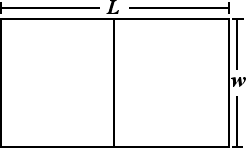
It doesn't really matter which side I label as the "length" and which I label as the "width", as long as I label things clearly and work consistently.
With the labelling I've chosen, the length of fencing gives me a "perimeter" of:
2L + 3w = 1200
(Perimeter was in quotes, because I'm also including the center divider in the total length. Strictly speaking, the perimeter doesn't include that center divider. But you know what I mean.)
Solving this equation for one of the variables, I get:
2L + 3w = 1200
L + 1.5w = 600
L = −1.5w + 600
Then the area, being the product of the width and the length, is given by:
A = Lw
= (−1.5w + 600)w
= −1.5w2 + 600w
To maximize this area, I have to find the vertex. Since all I need are the dimensions (not the area), all I need from the vertex (h, k) is the value of h, since this will give me the maximizing width.
Then the length will be:
L = −1.5(200) + 600
= −300 + 600 = 300
Now I have both dimensions. The exercise didn't ask for the area to be enclosed; it asked only for the dimensions. But, to be complete, I will also include in my answer where the center divider will go.
The paddock should be 300' by 200', with the divider running parallel to the 200-foot-long side.

Notice that, with the divider running down the middle of the paddock, you don't get a square as being the maximal shape. If they throw in cost considerations (like putting prettier but more expensive fencing on the side of the paddock facing the street), you'll get odd-sized results, too.
Moral? Don't just assume that the maximal rectangular shape will always be a square.
In many quadratic max/min problems, you'll be given the formula you need to use. Don't try to figure out where they got it from. Just find the vertex. Then interpret the variables to figure out which number from the vertex you need, where, and with what units.
- Your factory produces lemon-scented widgets. You know that each unit is cheaper, the more you produce. But you also know that costs will eventually go up if you make too many widgets, due to the costs of storage of the overstock. The guy in accounting says that your cost for producing x thousands of units a day can be approximated by the formula C = 0.04x2 − 8.504x + 25302. Find the daily production level that will minimize your costs.
As you might guess, it will be a lot easier to use the vertex formula to find the minimizing value for this quadratic than it would be to complete the square. So I'll use the vertex formula:
Since the inputs to the formula they gave me are the production levels (in thousands of units), I've found the number I need. The other number for the vertex would be the actual costs for making this amount of widgets, and the problem doesn't ask for that.
I do need to remember, though, that x is in thousands of units, so my best level of production is not 106.3 units, but (106.3)(1,000) = 106,300 units.
I will minimize my costs if I produce 106 300 units a day.
Sometimes you'll get hit with a problem that seems much more complicated, especially when you have to invent the formula yourself.
- You run a canoe-rental business on a small river in Ohio. You currently charge $12 per canoe and average 36 rentals a day. An industry journal says that, for every fifty-cent increase in rental price, the average business can expect to lose two rentals a day. Use this information to attempt to maximize your income. What should you charge?
Let's imagine that I have no idea how to set this problem up. Instead of going straight to an equation, I'll need to run some real numbers through this set-up, observe what I do when I know what the values are until I see a pattern in what I'm doing, and then follow the pattern to get my formula.
Below is my working, neatly laid out in a table, so you can see what I did and the pattern I found:
| price hikes | price per rental | number of rentals | total income |
|---|---|---|---|
| no hike | $12 | 36 | ($12)(36) = $432 |
| 1 hike | $12 + 1($0.50) = $12.50 | 36 − 1(2) = 34 | ($12.50)(34) = $425 |
| 2 hikes | $12 + 2($0.50) = $13 | 36 − 2(2) = 32 | ($13)(32) = $416 |
| 3 hikes | $12 + 3($0.50) = $13.50 | 36 − 3(2) = 30 | ($13.50)(30) = $405 |
| x hikes | $12 + x($0.50) | 36 − x(2) | ($12 + $0.50x)(36 − 2x) |
Then my formula for my revenues R after x fifty-cent price hikes is:
R(x) = (12 + 0.5x)(36 − 2x)
= 432 − 6x − x2
= −x2 − 6x + 432
The maximum income will occur at the vertex of this quadratic's parabola, being the point (h, k):
k = R(h)
= −(−3)2 − 6(−3) + 432
= −9 + 18 + 432
= 450 − 9
= 441
From this, I can see that my income will be maximized (assuming the journal article is correct) if I lower my current price of $12 by three times of fifty cents, or by $1.50. At this maximizing price, I will achieve my maximum income of $441.
I should charge $10.50 per canoe.
Whenever you're not sure of your formula, try doing what I did above: write out what you would do if you knew what the numbers were, and see if you can turn this into a formula. But make sure you write things out completely, like I did, so you can see the pattern.
Moral? Don't simplify too much in your head, or you could miss what your formula is supposed to be.
© 2024 Purplemath, Inc. All right reserved. Web Design by 