



Implicit Multiplication
Purplemath
What is "multiplication by juxtaposition"?
"Multiplication by juxtaposition" (also called "implicit multiplication") is what you use when you multiply two things without putting a "times" symbol (" × ") or a dot (" ⋅ ") between them.

"Juxtapostion" is the putting of two things next to each other; "implicit" means "not plainly expressed". So multiplication by juxtaposition is the act of writing an implicit product by placing the factors next to each other, rather than by putting an explicit symbol between them.
What is an example of multiplication by juxtaposition?
For example, when you multiply a number and a variable, such as 2 and x, you indicate this multiplication as 2x; you don't write the multiplication with a "times" symbol in the middle, like 2×x or 2⋅x. You can also indicate the multiplication of two numbers by using parentheses rather than by using a "times" symbol; in other words, you can write "the product of three and four" as (3)(4) rather than 3×4.
Multiplication by juxtaposition is usually quite helpful, and the meaning of an expression indicating multiplication in this manner is usually quite clear. But…
If you've spent any time on Facebook or other social media, you've likely encountered a "puzzler" that asks you to evaluate an (apparently simple) expression that includes division and multiplication. This division may be indicated by a slash (/) or by an obelus (÷). The expression will be typeset sideways, so the division is inline, rather than in fractional form. And whatever comes after the division is immediately followed by a parenthetical; that is, the division is immediately followed by multiplication by juxtaposition.
And this creates problems.
What is the problem with multiplication by juxtaposition?
The issue with multiplication by juxtaposition, specifically when this multiplication immediately follows division, is the precedence of the juxtaposition multiplication with respect to the regular multiplication and division in PEMDAS. The issue boils down to the question, "Is multiplication by juxtaposition 'stronger' somehow than regular multiplciation and division?" In other words, multiplication of any type comes after the P and the E in PEMDAS, but does multiplication by juxtaposition somehow come before the M and the D?
By the strict rules of PEMDAS (or PEDMAS, BODMAS, BEDMAS, etc), if your expression involves just multiplication and division, then you apply the operations from left to right. For instance, 6 ÷ 2 × 3 is simplified by first dividing the six by the two, and then multiplying the result by the three:
6 ÷ 2 × 3
(6 ÷ 2) × 3
(3) × 3
9
So far, so simple. But if we introduce multiplication by juxtaposition, simplification can become confusing. Suppose, for instance, we have the following expression instead of the one above:
6 ÷ 2(1 + 2)
The 1 + 2 obviously equals 3, and 2 × 3 obviously equals 2(3). But when we include that "six divided by" part, the arguing starts. Does the use of implicit multiplication (by using parentheses rather than a "times" symbol) somehow bind the 2 more tightly to the 3 than when there was a × symbol between them?
This issue first came to my attention when the students in a class I was teaching were split down the middle, vigorously arguing over which of two values was the correct answer to the following exercise:
- Simplify 16 ÷ 2[8 − 3(4 − 2)] + 1
When I was writing up the solution set, I simplified in (what I viewed as being) the usual way:
16 ÷ 2[8 − 3(4 − 2)] + 1
16 ÷ 2[8 − 3(2)] + 1
16 ÷ 2[8 − 6] + 1
16 ÷ 2[2] + 1 (**)
16 ÷ 4 + 1
4 + 1
5
(A Harvard professor has written about his encounter with a similar situation.)
The confusing part in the above calculation (and my students' point of contention) was with how "16 divided by 2[2] + 1" (in the line above that is marked with the double-star) became "16 divided by 4 + 1", instead of "8 times 2 + 1".
The issue arises from the position ("feeling"?) that, even though multiplication and division are at the same level (so the left-to-right rule of PEMDAS should apply), parentheses seem somehow to outrank regular multiplication and division, so the first 2 in the starred line is often regarded as going with the [2] that follows it, rather than with the "16 divided by" that precedes it. That is, the multiplication that is indicated by placement against parentheses (or brackets, etc) is often regarded (by science-y folks) as being stronger or tighter, somehow, than regular multiplication which is indicated by a "times" symbol of some sort, such as ×.

What is the source of the confusion with expressions like 6÷2(1+2)?
The source of confusion when trying to simplify this sort of expression is the fact that the division is written sideways — that is, inline — rather than vertically — that is, in fractional form. (Remember: Fractions *are* division.) If the expression were written vertically, then it would be obvious how much of the expression was actually divided into whatever came before the slash or division sign.
But the point of these puzzlers is that the division is *not* clear. Assumptions must be made. If one assumes strict PEMDAS, then one gets one answer; if one assumes implicit multiplication comes before regular multiplication (and division), then one gets another answer.
If you've been working in the sciences for a while, you will likely have somehow absorbed the unwritten rule that, given an expression like "1/2x", both the 2 and the x are together below the 1; that is, that the expression means .
Why isn't implicit multiplication included in PEMDAS?
Multiplication by juxtaposition (that is, implicit multiplication) isn't included in PEMDAS probably because of the origin of PEMDAS. People working in the maths and sciences had been using the order of operations for centuries ("millennia"?) before PEMDAS was cooked up. The rules were learned implicitly, via practice while learning and using mathematics. And nobody would write something like the horizontal fraction "1/2x by hand, because it is easier and more clear to write the division vertically. This issue of multiplication by juxtaposition simply hadn't come up.
And even today, it hardly comes up outside of the Facebook argument-starters.
Typesetting the entire expression in a graphing calculator can seem to confirm the priority of implicit multiplication:
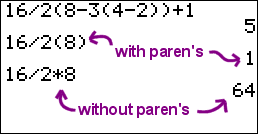
But different software packages *will* process this expression differently; even different models of Texas Instruments graphing calculators will process this expression differently.
The general consensus among math and science people is that multiplication by juxtaposition (that is, implicit multiplication) indicates that the juxtaposed values must be multiplied together before processing other operations. Computer science can arguably be used to support this position, and a real-life application of physics would seem to confirm this consensus. The primacy of implicit multiplication over regular multiplication and divison is my position, and is what I teach in my classes. (If "implicit multiplication" is I, then I guess I use PEIMDAS? BOIDMAS?)
As you might expect, some teachers (about half of them) view things differently. If you are in doubt as to what your specific instructor prefers, ask now, before the next test. And, when typing things out sideways (such as in an email), always take the time to be very careful of your parentheses so that you make your meaning clear and avoid precisely this ambiguity.
By the way: Please do not send me an e-mail either asking for or else proffering a definitive verdict on this issue. As far as I know, there is no such final verdict. Telling me to do things your way will not solve the issue, any more than have the various threads on StackExchange, Reddit, Quora, and PhysicsForums, among other places. Yes, people view this issue differently. Yes, the group doing the arguing usually splits fairly neatly down the middle. No, the sound and fury doesn't generally convince anybody of anything. Sorry.
(For an example of the sort of e-mails I get on this, continue to the next page, which also contains more fractional-form examples.)
© 2024 Purplemath, Inc. All right reserved. Web Design by 