



Evaluating Functions
Purplemath
The last example on the previous page brings us to the topic of evaluating equations, formulas, and functions at a given value of the input variable (usually x). Most of the evaluation you'll be doing in your mathematical career will reflect this process of plugging a given value in for a specified variable in a formula or function.

Evaluating equations works very much like evaluating expressions. However, equations, formulas, and functions have "equals" signs in them. So instead of simplifying a single expression to get a numerical value, we'll be simplifying part of an equation in order to find the value of whatever is the remaining variable.
What is an example of evaluating an equation?
- Evaluate y = 4x − 3 at x = 0
This question is asking me to find the value of y when x is 0. To get the answer, I will plug in the given value of x, and chug my way through the computations to find the corresponding value of y.
y = 4(0) − 3
= 0 − 3
= −3
My answer is not just the number. I wasn't asked to simplify an expression; I was asked to evaluate a function or formula for a given value of one variable, in order to find the corresponding value of the remaining variable. So my answer is:
y = −3
Note: The answer above, y = −3 when x = 0, means that the point (0, −3) is on the graph of the equation y = 4x − 3.
- Evaluate y = 4x − 3 at x = 3
This evaluation is asking me to find the value of y when x is 3. So I'll plug-n-chug:
y = 4(3) − 3
= 12 − 3
= 9
Then my answer is:
y = 9
This tells me that, were I to be graphing the line y = 4x − 3, the point (3, 9) would be on the line.

By the way, evaluating the same equation at three or more points like this, and getting a list of points, is how you plot points and graph equations.
In the case of the equation y = 4x − 3, the points from the evaluating we've done (including the point from the previous page) are: (−1, −7), (0, −3), and (3,−9).
Plotting these points and putting a straight line through them, we get the graph shown below:
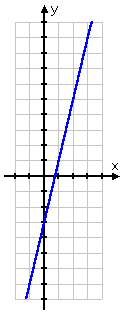
If you're not sure about this, you can verify from the picture that the three points we found are indeed on the graph by locating each point on the plane, and seeing that each point is crossed by the graph.
Evaluating formulas works just like evaluating equations, in that the formula will have an "equals" sign in it, and we'll be solving for the value of the one remaining variable. But formulas (such as in geometric formulas) will often have many more than just two variables.
What is an example of evaluating a formula?
- Given that the length of a rectangular prism is L = 4 units, the height is h = 6 units, and the depth (that is, the distance from front to back) is b = 2 units, find the volume V of the prism.
The volume is given by the formula V = Lhb. To find the volume, I need to plug the given numbers in for the appropriate variables, and simplify. This is just like the simplification I did for equations. The only difference here is that I've got three values to plug in.
V = (4)(6)(2) = 48
They didn't tell me what the "units" are, but I know that volume involves cubed units, so my answer is:
V = 48 units3
- Given that a right circular cylinder has a volume V of 308 cubic centimeters and a radius of r of 14 centimeters, find the height h of the cylinder. (Use for π.)
I usually think of plugging into formulas as plugging numbers into one side of the "equals" sign, and simplifying to find the value of whatever name (volume, surface area, arc length, etc) is on the other side. In this case, though, I'll have to solve. But after I've plugged in every value that they've given me, I should end up with just one variable left. I'll solve for that variable to get my answer.
They did give me named units for this exercise, so I know that the answer is:
h = 0.5 cm
You will also eventually need to evaluate functions. Instead of asking you to plug a certain value of x into an equation, they'll use function notation to tell you what value to use for your plug-n-chug.
What is an example of evaluating a function?
-
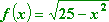
Given the function , evaluate f (−3).
To evaluate a function, I do just what I did above when evaluating equations: I plug in the given value for x. Here, I am supposed to evaluate at the value x = −3. The notation is different, but "f (−3)" means exactly the same thing as "evaluate 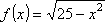 at x = −3".
So, to answer this question, I'll plug in −3 for x in the expression for f (x):
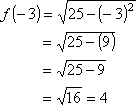
Then my answer is:
f (−3) = 4
Note how I used parentheses when I was plugging the given value into the function. It is very easy to mess up the minus signs if you're not careful. There's no harm in using lots of parentheses, especially if you're just starting out. Take the time to be careful!
Also, don't make the mistake of confusing "simplifying a square root" with "solving a quadratic by taking square roots". The evaluated, or simplified, value of a square root is defined to be the positive result. It's only when you're solving by taking square roots that you use a "±" sign on the radical.
- Given the function , evaluate f (3)
Since the value they're having me plug into the function is positive, the parentheses aren't quite as crucial in this evaluation. But, to be on the safe side, I'll use them anyway, so I don't accidentally square the "minus" that comes before the variable.
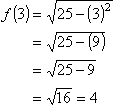
So my answer is:
f (3) = 4
- Given the function , evaluate f (−1)
I'm evaluating the function at a negative x-value, so I'll be sure to use parentheses.
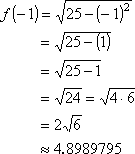
The instructions didn't say in what format I should give my answer. Since there is no particular need to round, I'll give my answer in "exact" form, though I'll leave the rounded form in my work shown, for completeness (and because I can compare in my calculator the value of this approximation with the value of the approximation of the square root of 24, to check my work before I hand in the test, for instance).
I could have given my answer is each of the two formats: the "exact" form (with the radical in it) and the "approximate" form (with the wiggly "equals" in front) from my calculator. Usually you will be expected to evaluate exactly; that is, it will usually be correct to in terms of a radical, or a fraction, or with pi in it (instead of, for instance, rounding π to 3.14. However, there will be times when the approximate form is better, especially in terms of being more useful. This will most often be the case in word problems, where you may need a value that can be applied in "real life".
For instance, "the square root of 24 meters" isn't very useful when you're trying to figure out to what length to cut a board, but "about 4.9 meters" is perfectly useful, and probably accurate enough for whatever you're building. You will also need to approximate for when you're graphing. For instance, I would have no idea where to plot the square root of 24, but I know right where to draw the line for 4.9.
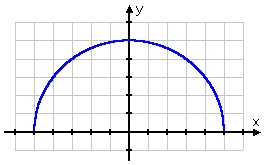
Evaluating functions is important, because we graph functions just like we graph other equations: by picking a few values of x, plugging them into the function, evaluating, drawing the points, and connecting the dots. (This is exactly what a graphing calculator does, by the way.) The graph of the function used in the three examples above looks like this:
Just remember: "evaluate" means "plug-n-chug". Be careful with the subtractions, negatives, and exponents (by using parentheses appropriately). Don't try to do too much at once; don't skip steps, don't try to do three steps at once, and don't try to do everything in your head. Take your time, and evaluation problems should work out fine.
© 2024 Purplemath, Inc. All right reserved. Web Design by 