



Determinant Word Problems
Purplemath
Nearly always, you'll be working with determinants, in order to solve systems of linear equations. Even most word problems that ask you to use determinants will reduce to your creating a system of linear equations and then — you guessed it! — solving the system with determinants.

But there are a couple of tricks that you can do with determinants, and these tricks can be turned into word problems. If your textbook covers different types of determinant-application word problems, be sure to memorize whatever is the trick for doing them, and expect to see at least one determinant-based word problem on the next test; there might even be one of these on the final. But you'll quite possibly never need these techniques after your current math class is finished.
What is an example of finding a triangle's area with a determinant?
- A triangle has vertices at (1, 2), (3, −4), and (−2, 3). Find the area of the triangle.
I could try to find the area by plotting these points, drawing the sides, and working from the drawing of the triangle, but this can get complicated, or at least time-consuming, for triangles (like this one) that don't have any sides running parallel to either of the axes. So what to do?
Instead of trying to work with equations generated by the drawing, I will instead put the vertices of the triangle into a determinant D, with the x-values from the three vertices being listed in the first column, the corresponding y-values being listed in the second column, and the third column all filled with 1's, like this:

I remember that the area formula for a triangle with base b and height h is A = ½bh. So I will add the ½ in front of the determinant. Then I'll evaluate:
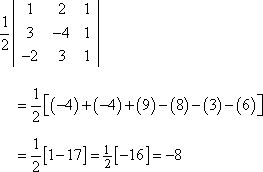
Whoa! A negative area? Is that possible? No, of course not! So is the formula wrong? Sort of.
I recall that a determinant can be negative, while areas (and absolute values) cannot. To account for this, the formula for the area of a triangle, given the coordinates of its three corners, is actually ±½D, where I chose whichever of "+" and "−" that will give me a positive answer.
This means that my work ends up like this:
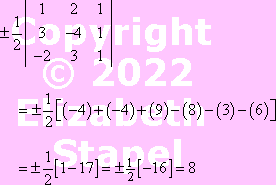
Then the area of the triangle is:
8 square units
In this exercise, no units were specified at the beginning, so you can probably get away with just saying "8", without the "square units" part. But, fyi, it wouldn't hurt to get in the habit of at least checking to see if they've mentioned units anywhere in the exercise statement.
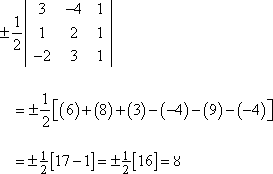
When using a determinant to find the area of a triangle, does it matter in which order you list the points inside the determinant? No. As long as the x-values and the corresponding y-values are kept together, it doesn't matter the order in which they are listed within the determinant.
Here are one of the other five possible rearrangements:
Here's another one:
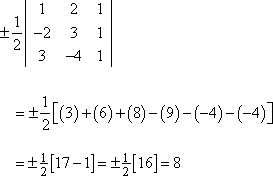
The order of the points in the determinant doesn't matter because changing the order of the rows in a determinant doesn't change its value, except for maybe changing the sign.
(Why does this determinant formula work? Because reasons.)
What is an example of finding a parallelogram's area with a determinant?
- A parallelogram has vertices at (−3, 4), (−1, −2), (1, 3), and (3, −3). Find its area.
A triangle can be viewed as being half of a parallelogram, so the area of a triangle is half that of a parallelogram. Then the formula for the area of a parallelogram is just the formula for the area of a triangle, but without the ½ in front. But which three points do I plug into the formula?
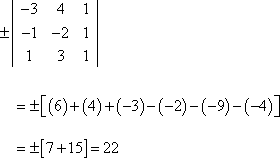
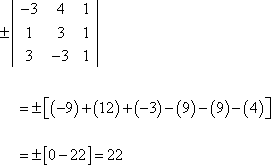
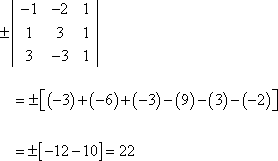
I've got four points to choose from, and it turns out that it really doesn't matter which three I choose. I can pick any three that I want:
using the points (−3, 4), (−1, −2) and (1, 3):
using the points (−3, 4), (1, 3) and (3, −3):
using the points (−1, −2), (1, 3) and (3, −3):
using the points (−3, 4), (−1, −2) and (3, −3):
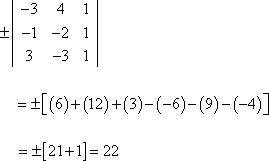
No matter the choice of three points or their order, my answer is always the same. So the area of the parallelogram they've given me is:
22 square units
Note that, in the second and third cases above, I had to change the sign to get a positive area. But in all cases, I got the same-sized value.
By the way, your instructor may try to confuse you on the next test by asking you to find the area of a rectangle or square. But rectangles and squares are just special cases of parallelograms, so you can use the same method for finding their areas, too.

What is an example of finding a line's equation with a determinant?
- A line passes through the point (2, 3) and (−3, 1). Find its equation.
Normally, I would take the two points and use them to find the slope of the line. Then I'd pick one of the points, and plug the slope and that point's coordinates into the slope-intercept form to find the line's equation.
But I can use a determinant to find the same thing.
I set up a determinant with an x-column, and y-column, and an all-ones column, and set it equal to zero, like this:
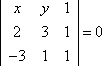
Then I evaluate and simplify:
(x)(3)(1) + (y)(1)(−3) + (1)(2)(1)
− (−3)(3)(1) − (1)(1)(x) − (1)(2)(y) = 0
3x − 3y + 2 + 9 − x − 2y = 0
2x − 5y + 11 = 0
Then the line has the following equation:
2x − 5y = −11
The format for the answer to this type of exercise will vary from text to text, so make a note of how your book does it, and match that format.
This exercise, asking you to find a line equation in terms of its two variables, shows why you will need to be able to evaluate determinants by hand. Your teacher can give you an exercise like this that you cannot solve with your calculator; it can't handle the variables. So make sure you practice enough to learn the by-hand process.
© 2024 Purplemath, Inc. All right reserved. Web Design by 