



2-by-2 Determinants
Purplemath
What is a determinant?
Given a square matrix (and it *must* be a square one) M, the corresponding determinant is an array of the exact same entries in the exact same order, but those entries are enclosed in absolute-value bars instead of the square brackets (or maybe the parentheses) that enclose matrices.

The name "determinant" comes from their original use; namely, to "determine" whether a given system of linear equations had a unique solution.
In this lesson, I'll show you how to compute 2×2 and 3×3 determinants. It is possible to compute larger determinants, but the process is much more complicated, so I won't bother with that here.
What kind of math is determinants?
Determinants are derived from matrices, and matrices come from systems of linear equations. So determinants are a part of mathematics called "linear algebra" or "matrix algebra".
How do you use determinants?
There are (alleged to be) many ways that determinants can be used, in many areas of study and work. However, there are those who posit that other tools work just as well, and that determinants should get over themselves already. Their history might be interesting. But, other than for solving systems, you'll likely not see anything particular scintillating for a few years yet.
What is the notation for determinants?
Given a matrix B, the determinant of B is denoted by det(B), pronounced as "the determinant of B", or just "det-bee". When written out, the determinant swaps out the matrix's square brackets for absolute-value bars.
What kind of matrices have determinants?
Only a square matrix can have a determinant. Some people have tried to define various pseudo-determinants for non-square matrices, but I don't think they're catching on. All you'll ever hear of will be determinants for square matrices. Because reasons. If your matrix isn't square, it doesn't have a determinant.
How do you get a determinant from a matrix?
If you have a square matrix, its determinant is written by taking the same grid of numbers, removing the square brackets "[ ]", and replacing those brackets with absolute-value bars "| |", as shown below:
If this is
"the matrix A"...
![[[ 1 0 3 ][ 6 -2 1 ][ 0 3 0 ]]](matrices/determ01.gif)
...then this is "the determinant of A"

(To type absolute-value bars, use the "pipe" character, which is probably on the same keyboard key as the "backslash" character.)
How many elements are in a determinant?
A determinant will have the exact same number of elements as did the matrix that generated it. Or, if you prefer, a determinant of size n×n has n×n = n2 elements in it. So a 2×2 determinant has 4 elements in it, a 3×3 determinant has 9 elements in it, a 5×5 determinant has 25 elements in it, and so forth.
Just as absolute values can be evaluated and simplified to get a single number, so can determinants. The process for evaluating determinants can be pretty messy, so let's start simple, with the 2×2 case.
How do you find the determinant of a 2-by-2 matrix?
For a 2×2 matrix, its determinant is found by subtracting the products of its diagonals, which is a fancy way of saying in words what the following says in pictures:
the matrix A with variables:
![[[ a b ][ c d ]]](matrices/determ03.gif)
the determinant of A (or "det A"):

the matrix A with numbers:
![[[ 1 2 ][ 3 4 ]]](matrices/determ04.gif)
the determinant of A (or "det A"):

In other words, to take the determinant of a 2×2 matrix, you follow these steps:
- Multiply the values along the top-left to bottom-right diagonal
- Multiply the values along the bottom-left to top-right diagonal
- Subtract the second product from the first
- Simplify to get the value of the 2×2 determinant
In other words, given a generic 2×2 matrix:
...the formula for a 2×2 determinant is ad − cb.
"But wait!" I hear you cry; "Aren't absolute values always supposed to be positive? The numerical matrix above is shown as having a negative determinant. What's up with that?" You make a good point.
Can a determinant be negative?
Yes, determinants can be negative! Determinants are similar to absolute values, and use the same notation, but they are not identical, and one of the differences is that determinants can indeed be negative.
What is an example of finding a 2-by-2 determinant?
- Evaluate the following determinant:

In this exercise, they've given me a determinant (rather than a matrix), so I can get right to work. I multiply the diagonals (highlighted with purple arrows in my working below), and subtract:
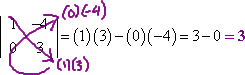
Then my answer is:
det(A) = 3

- Find the determinant of the following matrix:
![[[ 2 1 ][ -1 3 ]]](matrices/determ07.gif)
Here, they've given me a matrix, and asked me to find the determinant of it.
First, I'll convert from a matrix to a determinant by swapping out the brackets for absolute-value bars. Then I'll multiply along the diagonals (blue arrows below), subtract the products, and simplify to get my numerical answer:
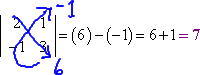
Then my answer is:
det(A) = 7
That's really all there is to 2-by-2 determinants. Just make sure you multiply and subtract in the right order, and you'll be fine.
© 2024 Purplemath, Inc. All right reserved. Web Design by 