



Straight-Line Equations: Point-Slope Form
Purplemath
In the previous lesson, we saw the slope-intercept form for straight lines. The other format for straight-line equations is called the "point-slope" form. For this one, they give you a point (x1, y1) and a slope m, and have you plug it into this formula:
y − y1 = m(x − x1)
Don't let the subscripts scare you. They are just intended to indicate the point they give you. You have the generic "x" and generic "y" that are always in your equation, and then you have the specific x and y from the point they gave you; the specific x and y are what is subscripted in the formula.

Here's how you use the point-slope formula:
Find the equation of the straight line that has slope m = 4 and passes through the point (−1, −6).
This is the same line that I found on the previous page, so I already know what the answer is (namely, y = 4x − 2). But let's see how the process works with the point-slope formula.
They've given me m = 4, x1 = −1, and y1 = −6. I'll plug these values into the point-slope form, and solve for "y=":
y − y1 = m(x − x1)
y − (−6) = (4)(x − (−1))
y + 6 = 4(x + 1)
y + 6 = 4x + 4
y = 4x + 4 − 6
y = 4x − 2
This matches the result I got when I plugged into the slope-intercept form. This shows that it really doesn't matter which method you use (unless the text or teacher specifies). You can get the same answer either way, so use whichever method works more comfortably for you.
You can find the straight-line equation using the point-slope form if they just give you a couple points:
Find the equation of the line that passes through the points (−2, 4) and (1, 2).
I've already answered this one, but let's look at the process. I should get the same result; namely:
Given two points, I can always find the slope:
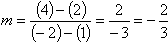
Then I can use either point as my (x1, y1), along with this slope I've just calculated, and plug these values into the point-slope form. Using (−2, 4) as the (x1, y1), I get:
y − y1 = m(x − x1)
y − (4) = ( − 2/3 )(x − (−2))
y − 4 = ( − 2/3 )(x + 2)
y − 4 = ( − 2/3 ) x − 4/3
y = ( − 2/3 ) x − 4/3 + 4
y = ( − 2/3 ) x − 4/3 + 12/3
This is the same answer I got when I plugged the same information into the slope-intercept form on the previous page. So, unless your text or teacher specifies the method or format to use, you can (and should!) use whichever format suits your taste, because you'll get the same answer either way.
In the worked examples in the next section, I'll use the point-slope formula, because that's the way I was taught and that's what most books want. But my experience has been that many students prefer to plug the slope and a point into the slope-intercept form of the line, and solve for b. If that works better for you, then use that method instead.
© 2024 Purplemath, Inc. All right reserved. Web Design by 