



Simplifying Nested Parentheses
Purplemath
Parentheses inside of other parentheses are called "nested" parentheses. The process of simplification works the same way as in the simpler examples on the previous page, but we do need to be a little more careful as we work our way through the grouping symbols.
And, by "working our way through", I mean "work our way out from the inside, simplifying as we go".

-
Simplify 3[2 − 1(32 − 23)]
The innermost parenthetical is the exponent stuff inside the parentheses. I'll start by simplifying this portion of the expression:
3[2 − 1(32 − 23)]
3[2 − 1(9 − 8)]
3[2 − 1(1)]
Simplifying inside the square brackets comes next.
3[2 − 1(1)]
3[2 − 1]
3[1]
3
There's nothing more that can be done with this, so my answer is:
3
You may be wondering why I didn't put "equals" signs between each of the lines above. While it would have been legitimate (mathematically) to do so, I've seen many students get confused about when the "equals" signs "matter", and when they don't.
To be clear, one must have "equals" signs when one is working with equations (that is, when one is working with "(one expression) equals (another expression)", and one has to solve for the value of a variable). One must have "equals" signs for working with equations. One does not have have to use them for simplifying stand-alone expressions. In hopes of avoiding some confusion, I try not to use "equals" signs when only simplifying. (More on this topic later.)
-
Simplify 4[x + 3(2x + 1)]
With nested parentheses, the safest plan is to work from the inside out. So I'll take the 3 through the inner parentheses first, before I even think about dealing with the 4 and the square brackets on the outside. I'll also simplify as much as I can, as I go along. I will write each step out completely as I go. I start with the original exercise, and then take the 3 through the innermost parenthetical:
4[x + 3(2x + 1)]
4[x + 3(2x) + 3(1)]
4[x + 6x + 3]
Now I can combine like terms (being the two variable-containing terms) to get:
4[7x + 3]
With the insides of the square brackets simplified, I can now start moving the 4 through the brackets:
4[7x + 3]
4[7x] + 4[3]
28x + 12
I can't combine these two terms, so I'm done.
28x + 12
By the way, there is no particular significance to the square brackets ("[" and "]") versus the parentheses versus the curly braces ("{" and "}"). Using the different grouping symbols is just a nice way of helping the user keep track of the different pairs of symbols. This is similar to working in certain spreadsheets, where the pairs of parentheses in a highlighted formula will be color-coded, as you can see below:
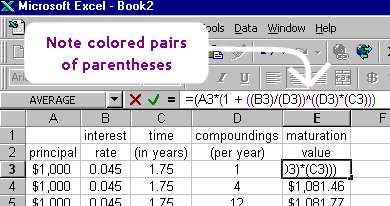
This color-coding helps you see which ")" character (that is, with which "close-paren") goes with which "(" character (that is, with which "open-paren") in a formula. The different types of grouping symbols in mathematics serve the same purpose as do the colored parentheses in the spreadsheet.
FYI: The traditional sequence of grouping symbols, working from the inside out, is "parentheses", then "square brackets", and then "curly braces"; then you repeat the sequence, as necessary. But this is not, to my knowledge, a rule; it's just a common convention.
-
Simplify −5{3 − 2[1 − 4(3 − 22)]}
Yeesh! Negatives, much?
I'll start from the innermost grouping symbols, being the parentheses.
−5{3 − 2[1 − 4(3 − 22)]}
−5{3 − 2[1 − 4(3 − 4)]}
−5{3 − 2[1 − 4(−1)]}
Now I can multiply by the 4 in front of the parentheses, and simplify inside the square brackets:
−5{3 − 2[1 − (−4)]}
−5{3 − 2[1 + 4]}
−5{3 − 2[5]}
And now I can simplify inside the curly braces, and then take the 5 through the braces to complete the simplification:
−5{3 − 10}
−5{−7}
+35
This expression happened not to have any variables, so I was able to simplify all the way down to a simple number, which is my hand-in answer (though I'll leave off the "plus" in front of the number, because it is neither necessary nor customary).
35
Yes, you should expect at least one problem like this, with all the "minus" signs, on the next test. Don't try to do too many steps at once, when you're simplifying messes like this. Take your time, and write out however many steps you need.
-
Simplify 9 − 3[x − (3x + 2)] + 4
I won't do anything with the "9 −" or the "+ 4" until I simplify what's inside the brackets and the parentheses. I'll work from the inside out, inserting the "understood" 1 where I find it helpful:
9 − 3[x − (3x + 2)] + 4
9 − 3[x − 1(3x + 2)] + 4
9 − 3[x − 1(3x) − 1(2)] + 4
9 − 3[x − 3x − 2] + 4
9 − 3[−2x − 2] + 4
9 − 3[−2x] − 3[−2] + 4
9 + 6x + 6 + 4
6x + 19
I can't combine these terms, so there's nothing left to simplify. My answer is:
6x + 19
It is not required that you write out this many (or this few) steps. You should be careful to do one step at a time, though, writing things out completely and simplifying as you go. You should do as many steps as you need in order to consistently arrive at the correct answer.
-
Simplify 5 + 2{[3 + (2x − 1) + x] − 2}
I'll work carefully from the inside out, starting with the parentheses in the middle, then moving outward to the brackets, and then on to the braces.
5 + 2{ [3 + (2x − 1) + x] − 2}
5 + 2{ [3 + 2x − 1 + x] − 2}
5 + 2{ [2x + x + 3 − 1] − 2}
5 + 2{ [3x + 2] − 2}
5 + 2{3x + 2 − 2}
5 + 2{3x}
5 + 6x
This answer is mathematically correct, but I'll rearrange the terms into descending order, for custom's sake.
6x + 5
© 2024 Purplemath, Inc. All right reserved. Web Design by 