



Proof of the Arithmetic Summation Formula
Purplemath
The sum, Sn, of the first n terms of an arithmetic series is given by:
On an intuitive level, the formula for the sum of a finite arithmetic series says that the sum of the entire series is the average of the first and last values, times the number of values being added.
![(n/2)(a-sub-1 + a-sub-n) = n [ (a-sub-1 + a-sub-n) / 2 ]](series/sum35.gif)

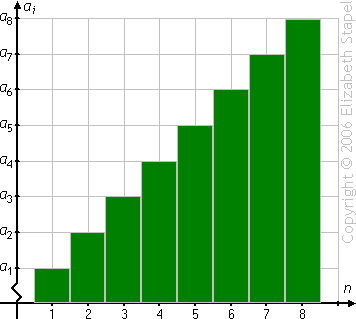
This makes sense, especially if you think of a summation visually as being the sum of the areas of the bars pictured below:
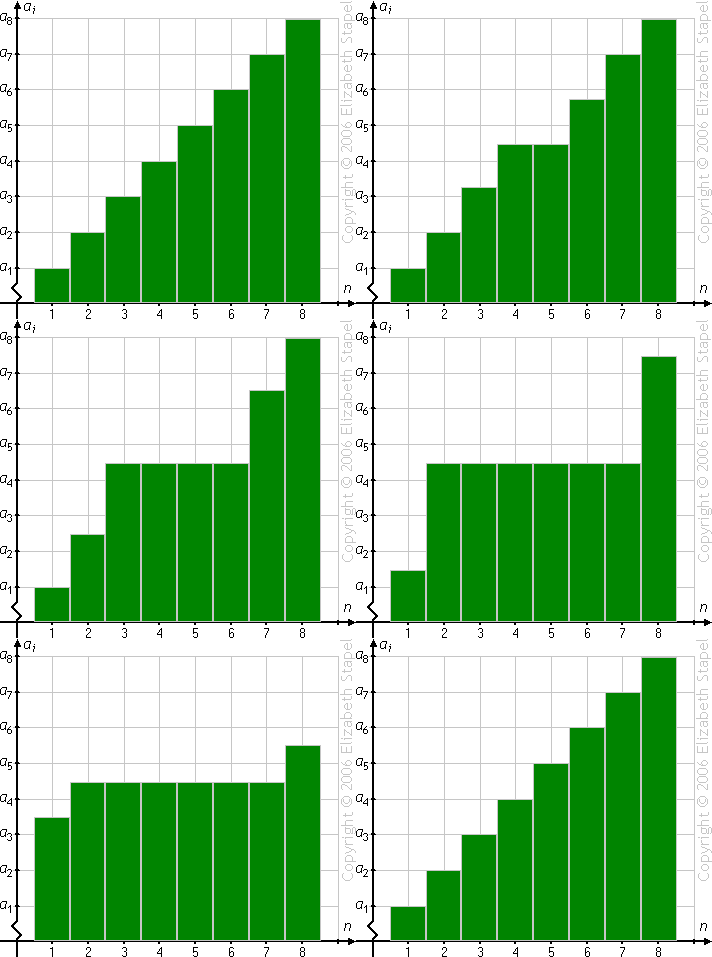
Since the bars grow by a fixed amount at each step, you can, in effect, "average" the bars to get the total area:
While the pictures are helpful in providing a sense of what is going on, they don't prove anything in the mathematical sense. To prove this formula properly requires a bit more work. We will proceed by induction:
Prove that the formula for the n-th partial sum of an arithmetic series is valid for all values of n ≥ 2.
Proof: Let n = 2. Then we have:

For n = k, assume the following:

Let n = k + 1. Then we have:
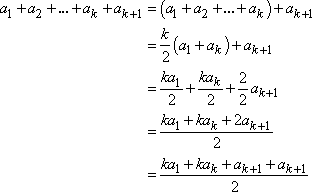
By nature of arithmetic sequences, we have:
ak = ak+1 – d
ak+1 = a1 + kd
Then, substituting the above into the n = k + 1 expression, we have:
![= (ka_1 + ka_(k+1) + a_1 + a_(k+1)) / 2 = [ (k + 1) / 2 ] [a_1 + a_(k+1)]](series/sum39.gif)
Therefore the result holds for n = k + 1, and the formula is proved for all n ≥ 2. Q.E.D.
© 2024 Purplemath, Inc. All right reserved. Web Design by 