



Basic Geometric Word Problems
Purplemath
Sometimes geometry word problems wrap the geometry in a thick layer of "real life". You will need to be able to visualize the geometry, and extract the relevant information from all the verbiage.
That said, once you know those formulas, many geometry exercises are pretty straightforward.
- Suppose a water tank in the shape of a right circular cylinder is thirty feet long and eight feet in diameter. How much sheet metal was used in its construction?
What they are asking for here is the surface area of the water tank.
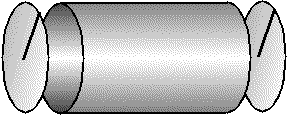
The total surface area of the tank will be the sum of the surface area of the side (that is, of the long cylindrical part) and the surface areas of the two ends (that is, of the two circular parts).
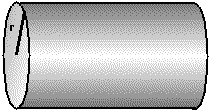
Here is a side view of the cylindrical tank, showing the radius r:
And here is an "exploded" view of the tank, showing the three separate surfaces whose areas I need to find.
If the diameter is eight feet, then the radius r is four feet. The surface area of each end is given by the area formula for a circle with radius r:
A = πr2
There are two end pieces — one at either end of the cylindrical part — so I will be multiplying this area by 2 when I find my total-surface-area formula.
The surface area of the cylinder is the circumference of the circle, multiplied by the height (or length, if you're looking at it sideways, as we are here):
A = 2πrh
Then the total surface area of this tank, being the areas of the two ends and the "lateral" area of the cylinder, is given by:
2 × πr2 + 2πrh
= 2π(42) + 2π(4)(30)
= 2π × 16 + 240π
= 32π + 240π
= 272π
Since the original dimensions were given in terms of feet, then my area must be in terms of square feet:
total surface area: 272π square feet.
The units on the above answer could also be written as ft2. But, while linear feet (that is, feet that are measuring length) can be indicated with an apostrophe — so "seven feet long" can be written as 7' — you cannot use the apostrophe notation for square feet (area) or cubic feet (volume). You have to spell out the units, or else use the abbreviated form with an exponent.
(Only feet and inches have apostrophe or quote-mark notations; all other Imperial units, and all metric units, use letter-based abbreviations.)
By the way, this is one of those exercises that doesn't translate well into real life. In reality, the sheet metal has thickness, and adjustments would be required in order to account for this thickness.
For example, if you needed to figure out the amount of sheet metal required to create a tank with a certain volume, you'd have to account for the fact that the volume is on the inside, while the surface area is on the outside. Since the walls of a real-world tank have thickness, the real-world answer would not match the so-called ideal mathematical one.
- A piece of 16-gauge copper wire 42 cm long is bent into the shape of a rectangle whose width is twice its length. Find the dimensions of the rectangle.
Do I care that the wire is made of copper, or that the wire is sixteen-gauge? No; all I care is that the length is forty-two units, that the units are centimeters, that the rectangle is twice as long in one direction as the other, and that I'm supposed to find the values of each of these directions. I can ignore the other information.
(The gauge measure, by the way, refers to thickness, and smaller number gauges are thicker than larger number gauges. For heavy-use tools, you might prefer a fourteen- or twelve-gauge wire.)
Since the wire is 42 centimeters long, then the perimeter of the rectangle is 42 centimeters. Plugging this into the perimeter formula, I get:
2L + 2w = 42
I also know that the width is twice the length, so:
w = 2L
I can use this to substitute for the w in the perimeter formula, giving me:
2L + 2(2L) = 42
2L + 4L = 42
6L = 42
L = 7
Since the width is related to the length by w = 2L, then w = 14 units. Looking back at the exercise statement, I note that the units are centimeters, so my answer is:
length: 7 cm
width: 14 cm
- A circular swimming pool with a diameter of 28 feet has a deck of uniform width built around it. If the area of the deck is 60π square feet, find its width.
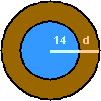
They're talking about a pool that is surrounded by a deck. For my geometrical purposes, they're talking about one circle surrounded by another circle, with both sharing the same center point. The pool (that is, the inner circle) has a width, or diameter, of twenty-eight units, so it has a radius of 14 units. The surrounding deck (that is, the outer circle) has width, or diameter, of d units.
The area of the pool is given by:
πr2 = π(14)2 = 196π
They've given me that the area of the decking is 60π square units. Then the total area of the pool plus the surrounding decking is:
196π + 60π = 256π
Working backwards from the area formula, I can find the radius of the whole pool-plus-deck area:
256π = πr2
256 = r2
16 = r
Since I already know that the pool has a radius of 14 units, and I now know that the whole area has a radius of 16 units, then I'm left with a remaining width of 16 − 14 = 2 units. Looking back at the exercise statement, I'm reminded that those units are feet. Then my answer is:
deck width: 2 ft

- If one side of a square is doubled in length and the adjacent side is decreased by two centimeters, the area of the resulting rectangle is 96 square centimeters larger than that of the original square. Find the dimensions of the rectangle.
I'm starting from a square with sides of some unknown length. The sides of the rectangle are defined in terms of that unknown length. So I'll pick a variable for the unknown side-length, create expressions for the rectangle's sides, and then work from there.
square's side length: x
one side is doubled: 2x
next side is decreased by two: x − 2
square's area: x2
rectangle's area: (2x)(x − 2) = 2x2 − 4x
The new area (being the area of the rectangle) is 96 square units more than the old area (being the area of the original square). This gives me my equation:
2x2 − 4x = x2 + 96
This is a quadratic equation, which I know how to solve:
2x2 − 4x = x2 + 96
x2 − 4x − 96 = 0
(x − 12)(x + 8) = 0
x = 12, −8
I'm supposed to find the dimensions (that is to find the lengths of the sides) of a rectangle. Can I just erase the minus solution and say that the rectangle is 12 by 8? No! (This is an example of where that "cheat" doesn't work.)
Looking back at my work, I see that I defined x as standing for the side length of the original square, not as one of the sides of the rectangle. Interpreting this in context, x = 12 (the only reasonable solution for a length) gives the length of the sides of the original square.
But they didn't ask me for the dimensions of the original square; they asked for the dimensions of the rectangle.
Since one side of the rectangle is twice the length of the sides of the original square, then the long dimension must have a length of 2 × 12 units, or 24 units. The short dimension of the rectangle, being two units less than the side length of the original square, must be 12 − 2 = 10 units.
Looking back at the exercise statement, I see that they only asked me for the dimensions of the rectangle, not its area; and that the unit for this exercise is centimeters. Then my answer is:
length: 24 cm
width: 10 cm
© 2024 Purplemath, Inc. All right reserved. Web Design by 