



The Domain and Range of Functions
Purplemath
Let's return to the subject of domains and ranges. When functions are first introduced, you will probably have some simplistic "functions" and relations to deal with, usually being just sets of points. These won't be terribly useful or interesting functions and relations, but your text wants you to get the idea of what the domain and range of a function are.
What are the domain and range?
The domain of a relation (and thus also the domain of a function) is the set of allowable inputs; it is the set of all the x-values in the (x, y) points determined by the relation. The range of a relation (and thus also the range of a function) is the set of resulting outputs; it is the set of all the y-values in the (x, y) points determined by the relation.
How can you remember which is the domain and which is the range?
There's an old cowboy song where the chorus starts, "Home, home on the range / Where the deer and the antelope play"; you're probably hearing it in your head right now. Sing the chorus instead as "Domain, domain on the range", and this will help you keep straight which is which.
Imagine that you're living on a little homestead in the middle of the big wide-open. Your home is your domain; it's where you start your day. Once you're up, you go grab a horse and head out into the big wide-open, being the rangelands of the plains. The domain is where the relation starts; the range is where it goes to work.
(Hey, the musical thing may be stupid, but it works for some of us, okay?)
Small sets containing just a few points are generally the simplest sorts of relations, so your book starts with those.
What are the domain and range of a set?
Given a set of ordered pairs (x, y), the domain is the set of all the x-values, and the range is the set of all the y-values.
What is an example of finding the domain and range of a set of points?
- State the domain and range of the following relation. Is the relation a function?
{(2, −3), (4, 6), (3, −1), (6, 6), (2, 3)}
The above list of points, being a relationship between certain x's and certain y's, is a relation. The domain is all the x-values, and the range is all the y-values. To give the domain and the range, I just list the values without duplication:
domain: {2, 3, 4, 6}
range: {−3, −1, 3, 6}
(It is customary to list these values in numerical order, but it is not required. Sets are, by definition, *unordered* lists, so you can list the numbers in any order you feel like. Just don't duplicate: technically, repetitions are okay in sets, but most instructors would count off for this.)
While the given set of points does indeed represent a relation (because x's and y's are being related to each other), the set they gave me contains two points with the same x-value: (2, −3) and (2, 3). Since x = 2 gives me two possible destinations (that is, two possible y-values), then this relation cannot be a function.
And, when the relation they've given me is a set of points, all I need to do is check the points' x-values; if any x-value shows up more than once, then the relation is not a function. This relation has repeates, so it is not a function. Then my answer is:
domain: {2, 3, 4, 6}
range: {−3, −1, 3, 6}
this relation is not a function
Note that all I had to do to check whether the relation was a function was to look for duplicate x-values. If you find any duplicate x-values, then the different y-values mean that you do not have a function. Remember: For a relation to be a function, each x-value has to go to one, and only one, y-value.
- State the domain and range of the following relation. Is the relation a function?
{(−3, 5), (−2, 5), (−1, 5), (0, 5), (1, 5), (2, 5)}
All I have to do for the domain and range parts of this exercise is list the x-values for the domain and the y-values for the range. I remember to use curly-brace set notation for each:
domain: {−3, −2, −1, 0, 1, 2}
range: {5}
This is another example of a "boring" function, just like the example on the previous page: every last x-value goes to the exact same y-value. But each x-value is different, so, while boring, this relation is indeed a function. So my complete answer is:
domain: {−3, −2, −1, 0, 1, 2}
range: {5}
this relation is a function
In point of fact, these points lie on the horizontal line y = 5.
By the way, the name for a set with only one element in it, like the "range" set above, is "singleton". So the range could also be stated as "the singleton set of 5".
There is one other situation in which you'll need to be able to find the domain and range of functions. They will give you a function and ask you to find the domain (and maybe the range, too). I have only ever seen (or can even think of) two things at this stage in your mathematical career that you'll have to check in order to determine the domain of the function they'll give you, and those two things are denominators and square roots.
How do you find the domain and range of a function?
To find the domain of a function, you must figure out which x-values will work in the formula for the function. At this point in your studies, this means that you'll need to check for square roots (because you can't have negatives inside square roots) and you'll need to check denominators (because you can't divide by zero).
To find the range of a function, it's usually helpful to look at the graph. Whatever y-values that the graph can reach will be the range. (Finding the range can be difficult sometimes; usually, you'll only be asked to find the domain.)
What is an example of finding the domain and range of a function?
- Determine the domain and range of the following rational function:

The domain is all the values that x is allowed to take on. The only problem I have with this function is that I need to be careful not to divide by zero. So the only values (that is, the only numbers) that x can not take on are those values which would cause division by zero.
So I'll set the denominator equal to zero and solve; my domain will be everything else.
x2 − x − 2 = 0
(x − 2)(x + 1) = 0
x = 2, x = −1
Then the domain is all x not equal to −1 or 2.
The range is a bit trickier (which is why they frequently don't ask for it). If they do want you to find the range, though, in general they'll want you to graph the function and find the range from the picture. In this case, here's my graph:
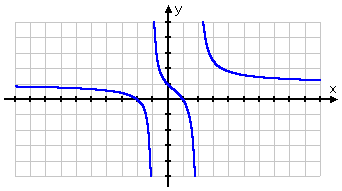
As you can see from my picture, the graph "covers" all y-values; that is, the graph will go as low as I like, and it will also go as high as I like. For any point on the y-axis, no matter how high up or low down, I can go from that point either to the right or to the left and, eventually, I'll cross the graph. Since the graph will eventually cover all possible values of y, then the range is all real numbers.
So my hand-in answer is:
domain: x ≠ −1, 2
range: all real numbers
Note: The expression "all real numbers" can also be stated as (−∞, ∞).
-
Determine the domain and range of the given function:

The domain is all values that x can take on. The only problem I have with this function is that I cannot have a negative inside the square root. So I'll set the insides greater-than-or-equal-to zero, and solve. The result will be my domain:
−2x + 3 ≥ 0
−2x ≥ −3
2x ≤ 3
Then the domain is all .
The range requires a graph. I need to be careful when graphing radicals:
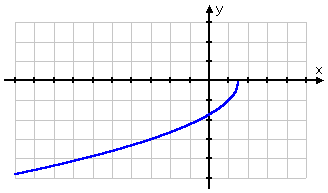
The graph starts at y = 0 and goes down (heading to the left) from there. While the graph goes down very slowly, I know that, eventually, I can go as low as I like (by picking x-values that are sufficiently big). Also, from my experience with graphing, I know that the graph will never start coming back up. Then the range is all y ≤ 0, and my hand-in answer is:
domain: all
range: all y ≤ 0

-
Determine the domain and range of the given function:
y = −x4 + 4
This is just a garden-variety polynomial. There are no denominators (so no division-by-zero problems) and no radicals (so no square-root-of-a-negative problems). There are no issues with a polynomial. There are no values that I can't plug in for x. When I have a polynomial, the answer for the domain is always "all x".
The range will vary from polynomial to polynomial, and they probably won't even ask, but when they do, I look at the picture:
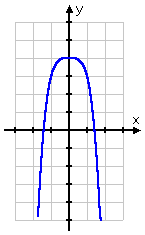
The graph goes only as high as the vertex, at y = 4, but it will go as low as I like. So the range is "all y ≤ 4". This is the second piece of information they'd wanted, so my hand-in answer is:
domain: all x
range: y ≤ 4
© 2024 Purplemath, Inc. All right reserved. Web Design by 