



Composing Functions with Other Functions
Purplemath
Thus far, we have done composition by points, with those points either listed in sets or else displayed on graphs; and we have evaluated compositions at given input values.
We can also evaluate compositions symbolically; that is, without a numerical input value.
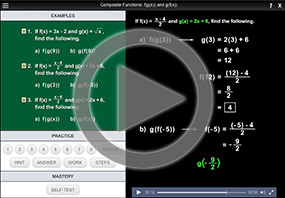
What's the difference between evaluating at an expression and composing with another function?
In practice, there is not much difference between evaluating a function at a formula or expression, and composing two functions. There's a notational difference, of course, but evaluating f (x) at y2, on the one hand, and composing f (x) with g(x) = y2, on the other hand, have you doing the exact same steps and getting the exact same answer. So you've actually kinda already done function composition.
Until now, when you were given a function f (x), you could plug a number or another variable in for x. You could even get fancy and plug in an entire expression for x. For example, given f (x) = 2x + 3, you could find f (y2 − 1) by plugging y2 − 1 in for x to get:
f (y2 − 1) = 2(y2 − 1) + 3
= 2y2 − 2 + 3
= 2y2 + 1
In function composition, you're usually plugging entire functions in for the x. In other words, when you're doing composition of functions, you're almost always "getting fancy" with what you're plugging in to a function.
It is simpler to evaluate a composition at a point because you can simplify as you go, since you'll always just be plugging in numbers and simplifying at each step.
On the other hand, evaluating a symbolic compositon, where you're first plugging x into some function and then plugging that function into some other function, can be much messier. But the process works just as the at-a-number composition does, and using parentheses — to be carefully explicit at each step — will be even more helpful.
What is an example of composing one function's formula with another?
- Given f (x) = 2x + 3 and g(x) = −x2 + 5, find (f ∘ g)(x).
In this composition, I am not trying to find a certain numerical value. Instead, I am trying to find the formula that results from plugging the formula for g(x) into the formula for f (x).
I will write the formulas at each step, using parentheses to indicate where the inputs should go:
(f ∘ g)(x) = f (g(x))
= f (−x2 + 5)
= 2( ) + 3
= 2(−x2 + 5) + 3
= −2x2 + 10 + 3
= −2x2 + 13
This final line, being as simplified as I can go, gives me my answer.
(f ∘ g)(x) = −2x2 + 13
If you plug in 1 for the x in the above, you will get:
(f ∘ g)(1) = −2(1)2 + 13
= −2 + 13 = 11
This is the same answer we got before, when we were evaluating at a point. Previously, we'd plugged a number into g(x), found a new value, plugged that value into f (x), and simplified the result. This time, we plugged a formula into f (x), simplified the formula, plugged the same number in as before, and simplified the result. The final numerical answers were the same.
If you've done the symbolic composition (the composition with the formulas) correctly, you'll get the same values either way, regardless of the value you pick for x. This can be a handy way of checking your work.
- Given f (x) = 2x + 3 and g(x) = −x2 + 5, find (g ∘ f)(x).
In this exercise, I'll be doing the plug-n-chug in the opposite order from the previous exercise.
(g ∘ f)(x) = g(f (x))
= g(2x + 3)
= −( )2 + 5
= −(2x + 3)2 + 5
= −(4x2 + 12x + 9) + 5
= −4x2 − 12x − 9 + 5
= −4x2 − 12x − 4
This doesn't simplify any further, so I'm done.
(g ∘ f )(x) = −4x2 − 12x − 4

There is something you should note from these two symbolic examples. Look at the results I got:
(f ∘ g)(x) = −2x2 + 13
(g ∘ f)(x) = −4x2 − 12x − 4
That is, (f ∘ g)(x) is not the same as (g ∘ f )(x). This is true in general. You should assume that the compositions (f ∘ g)(x) and (g ∘ f )(x) are going to be different.
In particular, composition is not the same thing as multiplication. The open dot "∘" is not the same as a multiplication dot "•", nor does it mean the same thing.
Multiplication:
always true
f (x) • g(x) = g(x) • f (x)
Composition:
usually false
(f ∘ g)(x) = (g ∘ f)(x)
You cannot reverse the order in composition and expect to end up with the same result. Composition is not flexible like multiplication; composition is an entirely different process. Do not try to multiply functions when you are supposed to be plugging them into each other.
By the way, if you remember learning about the associative, commutative, and transitive properties of real numbers, and if you remember wondering, "Why do I need to know this stuff?", this is why: so that you can recognize here that the commutative property does not hold. Function composition is an operation which is not commutative.
- Given f (x) = 2x + 3 and g(x) = −x2 + 5, find (f ∘ f )(x).
Do not mistake this composition as being the square of the function f (x). Because function composition is not commutative, the result will *not* be equal to (f (x))2, which is 4x2 + 12x + 9. Instead, I get:
(f ∘ f )(x) = f (f (x))
= f (2x + 3)
= 2( ) + 3
= 2(2x + 3) + 3
= 4x + 6 + 3
= 4x + 9
This is as simplified as the expression can get, so I have my answer:
(f ∘ f )(x)) = 4x + 9
- Given f (x) = 2x + 3 and g(x) = −x2 + 5, find (g ∘ g)(x).
My work looks like this:
(g ∘ g)(x) = g(g(x))
= −( )2 + 5
= −(−x2 + 5)2 + 5
= −(x4 − 10x2 + 25) + 5
= −x4 + 10x2 − 25 + 5
= −x4 + 10x2 − 20
This is fully simplified, so my answer is:
(g ∘ g)(x) = −x4 + 10x2 − 20
© 2024 Purplemath, Inc. All right reserved. Web Design by 