



Complex Fractions: Technicalities
Purplemath
In the first example in the "Complex Fractions" lesson, I started with this exercise:
- Simplify the following complex fraction:
![[4 + (1/x)] / [3 + (2/x^2)]](rational/compfr01.gif)

By the time I'd finished with all my computations, I'd ended up with an answer of:
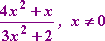
Why, in my fully-simplified answer, did I seem to complicate things by adding the restriction "for x ≠ 0" to the value of the variable?
For two rational expressions to be equal, they must have the same domain. If one of two otherwise-equivalent expressions "exists" for more x-values than does the other, then the two aren't actually equal. They may look the same, but the one has more space to roam than does the other. To be equal, the two expressions must be equivalent in all respects, including their domains.
To arrive at this "x not equal to zero" restriction, I had to consider all of the denominators in the stacked fraction, both of the entire fraction and of the sub-fractions (that is, the fractions contained within each of the complex numerator and the complex denominator). The two sub-fractions were the 1/x and the 2/x2 in the numerator and denominator, respectively:


Each of these expressions is undefined if x = 0.
Then I also have to consider the denominator of the whole complex fraction. Recall that, in my final simplified form of the fractional expression, the denominator was:
3x2 + 2
So the simplified form of the complex fraction will be undefined whenever 3x2 + 2 = 0. However, this is never equal to zero. Why? Because it's a squared term times a positive number, added to another positive number. The expression 3x2 + 2 will always be greater than or equal to 2.
x2 ≥ 0
3x2 ≥ 0
3x2 + 2 ≥ 2
As a result, this denominator gave me no additional restrictions on my answer.
Note: Some textbooks and instructors do care about these restrictions. (They all ought to, but that's a rant for another time.) If you are going to have to find these restrictions, then please pay very close attention to the denominators, both of the subfractions (when you're working with lowest common denominators) and of the simplified final answer. You will need to check every single one of these denominators for "equal to zero", in order to locate any and all necessary restrictions.
If you don't have to find these restrictions, be grateful (for now), and don't worry about these notes on the rest of the examples in this lesson.
© 2024 Purplemath, Inc. All right reserved. Web Design by 