



Factorials
Purplemath
What are factorials?
Factorials are very simple things; they're just products, and are indicated by an exclamation mark. For instance, "four factorial" is written as 4! and means the product of the whole numbers between 1 and 4.
1×2×3×4 = 24

What is the factorial symbol?
The factorial symbol is the exclamation mark, !, also called the exclamation point. This notation is used as a "trick" question sometimes: "What is the factorization of 120? It's 5!" They're not shouting "five!" or being surprised that it's "five?!?" They're saying that the prime factorization of 120 is the factorial of five, which is 1×2×3×4×5. Ha, ha. 🙄
In general, n! (pronounced as "enn factorial") means the product of all the whole numbers from 1 to n; that is, n! = 1×2×3×…×n.
(The factorial of zero, 0!, is defined to be equal to 1. Why? Because... reasons. Yes, 1! also equals 1. Just be sure to memorize the values: 0! = 1! = 1.)
What is an example of finding the value of a factorial?
- Evaluate 6!.
A factorial is just a product. To "evaluate" a factorial is simply to multiply it out. In this case, they're wanting me to "take the factorial of" 6. This means that I need to multiply all the whole numbers from 1 through 6, inclusive. My work is pretty simple:
1×2×3×4×5×6 = 720
This value is all they're looking for, so my answer is:
6! = 720
That's all there is to factorials, with respect to the notation, the lingo, and the concept. But factorials get really big, really fast, and you will almost certainly see factorial expressions with variables in them, or at least with really big numbers. In these situations, some helpful techniques can greatly simplify your work.

Can my calculator evaluate factorials for me?
Many (most?) calculators can evaluate factorials for you — as long as you're taking factorials of smaller numbers. (For larger numbers, the factorial will cause errors due to memory overflow issues, or else you'll be given some of the digits in the form of scientific notation. Neither option is helpful.)
For instance, the factorial command is available on the "probability" menu on one of my calculators:
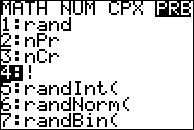
To use this, I first enter the number whose factorial is being taken. Then I open the probability menu, select the ! entry, and then hit enter. The calculator returns the value of the factorial.

On your calculator, look for a ! button (maybe as a second function) or an x! button, or else check your owner's manual.
- Simplify 12!
This factorial is the product of all the whole numbers between 1 and 12.
12! = 1×2×3×4×...
Oh, the heck with this. Where's my calculator...?
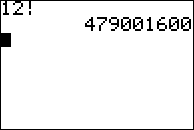
That was *much* easier! My answer is:
12! = 479001600
How big a factorial can a calculator handle?
Because factorials grow so quickly, nearly all calculators (and especially hand-helds) will quickly run out of memory or methods for storing all the digits of a factorial. My TI-84 Plus taps out after 13!, converting from a regular whole numbers to scientific notation. Even online calculators using Javascript or some other language generally convert to scientific notation by 16!, if not sooner. (There is one, though, that will accept integer entries up to 9999 into its online form.) So don't plan on being able to use your hand-held to find the values of expressions with large factorials.
When do we use factorials?
Factorials are commonly used in probability and statistics, when working with combinations and permutations. When you start doing combinations, permutations, and probability, you'll be simplifying expressions that have factorials in the numerators and the denominators. This is when understanding the definition of factorials will allow for simplifications that your calculator probably can't handle.
For instance:
- Simplify the following:

I can do this in my calculator:

I can also work from the definition of a factorial:
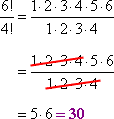
In either case, my answer is the same:
Note how I was able to cancel off a bunch of numbers in the previous problem. This is because of how factorials are defined — namely, as the products of all whole numbers between 1 and whatever number you're taking the factorial of — and this property can simplify your work a lot by allowing you to cancel off everything from 1 through whatever is the largest whole number that two of the factorials share.
What is an example of using cancellation to simplify fractions with factorials?
- Simplify the following:

Right away, I can cancel off the factors 1 through 14 that will be common to both 17! and 14!. Then I can simplify what little remains, which is much more manageable:
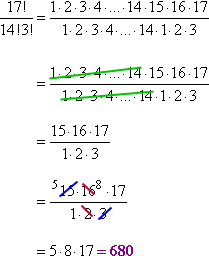
This final number is the answer they're looking for:
Notice how I shortened what I had to write by leaving a gap in the middle; namely, that part in the middle that I'd filled in with the "ellipsis", or triple-dot, notation. This gap-and-cancel process will become handy later on (like in calculus, where you'll use this technique a lot), especially when you're dealing with expressions that your calculator can't handle. For instance:
What is an example of simplifying factorials with variables?
- Simplify the following:

Because of the variables, my calculator can't evaluate this for me. I'll have to simplify this by hand. To do this, I will write out the factorials, using enough of the factors to have stuff that can cancel off.
Thinking back to "number" word problems, I recall that consecutive whole numbers are one unit apart, so the factors in the product (n + 2)! are of the form:
1×2×3×4×…× (n − 1) × (n) × (n + 1) × (n + 2)
Take another look at the above. By going back down the list of factors (starting from the right-hand side of the product) as far as "n − 1", I have created a list of factors that I can now cancel out, like so:
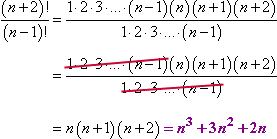
This cubic polynomial is the answer that they're wanting:
n3 + 3n2 + 2n
Make note of the way I handled that cancellation. I expanded the factorial expressions enough that I could see where I could cancel off duplicate factors. Even though I had no idea what n might be, I could still cancel. File this technique away in your brain, because even if you don't need it now, you will almost certainly need it later.
(In case you're here looking for information on finding the number of zeroes at the end of a factorial [like "How many zeroes are at the end of 23! after you multiply it out?"], this article has the info you're seeking.)
© 2024 Purplemath, Inc. All right reserved. Web Design by 