



Venn Diagrams: Set Notation
Purplemath
Venn diagrams can be used to express the logical (in the mathematical sense) relationships between various sets. The following examples should help you understand the notation, terminology, and concepts relating Venn diagrams and set notation.
Let's say that our universe contains the numbers 1, 2, 3, and 4, so U = {1, 2, 3, 4}. Let A be the set containing the numbers 1 and 2; that is, A = {1, 2}.
Note: The curly braces are the customary notation for sets. Do not use parentheses or square brackets.

Let B be the set containing the numbers 2 and 3; that is, B = {2, 3}. Then we can find various set relationships with the help of Venn diagrams. In what follows, I've used pinkish shading to mark the solution "regions" in the Venn diagrams.
For A = {1, 2}, B = {2, 3}, U = {1, 2, 3, 4}, find the following using a Venn diagram:
is pronounced as: A union B
means: the new set that contains every element from either of A and B; if a thing is in either one of these sets, it's in the new set
in terms of the elements:
Venn diagram:

my answer:
The Venn diagram above illustrates the set notation and the logic of the answer. Since "union" means "everything in either of the sets", all of each circle is shaded in. (If you're not clear on the logic of the set notation, review set notation before proceeding further.)
The following examples work in the same way.
is pronounced as: "A intersect B"
means: the new set that contains every element that is in both of the input sets; only things inside both of the input sets get added to the new set
in terms of the elements:
Venn diagram:

my answer:
-
(sometimes denoted as ~A or )
is pronounced as: "A complement" (or "not A", for the other notations)
means: the new set gets everything that is in the universe but is outside of A; it's okay if the element is in B, just so long as it is not also in A
in terms of the elements: {1, 2, 3, 4} − {1, 2}
Venn diagram:
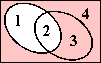
my answer:
The tilde ("TILL-duh") is the wiggly "~" character at the beginning of ~A; on your keyboard, the tilde is probably located at or near the left-hand end of the row of numbers. The tilde, in the set-relation context, says that I now want to find the complement (in a sense, the opposite) of whatever is being negated or "thrown out"; in this case, that's the set A. The kind of complement we see in this exercise, the "not" complement, means "throw out everything you have now (in this case, the set A) and take everything else in the universe instead".
Practically speaking, the "not" complement with the tilde says to reverse the shading, which is how I got the final picture above.
-
A − B (or A \ B)
is pronounced as: "A minus B" or "A complement B"
means: the new set gets everything that is in A except for anything in its overlap with B; if it's in A and not in B, then it goes into the new set; nothing from the overlap in the diagram (being the intersection of the input sets) goes into the new set
in terms of the elements: {1, 2} − {2, 3}
Venn diagram:

my answer: A − B = {1}
-
~
is pronounced as: "not (A union B)" (or "the complement of (A union B)")
means: the new set gets everything that is outside A and B; if something is in either of the input sets, it doesn't go into the new set
in terms of the elements: {1, 2, 3, 4} − ({1, 2} {2, 3}) = {1, 2, 3, 4} − {1, 2, 3}
Venn diagram:

my answer: ~
-
~
is pronounced as: "not (A intersect B)" (or "the complement of (A intersect B)")
means: the new set contains everything outside of the overlap of A and B; if something is in both of the input sets, then it isn't in the new set; everything outside of the overlap of the input sets (including everything in the universe but outside of the input sets) goes into the new set
in terms of the elements: {1, 2, 3, 4} − ({1, 2} {2, 3}) = {1, 2, 3, 4} − {2}
Venn diagram:

my answer: ~
There are gazillions of other possibilities for set combinations and relationships, but the above are among the simplest and most common. Some of the examples above showed more than one way of formatting (and pronouncing) the same thing. Different texts use different set notation, so you should not be at all surprised if your text uses still other symbols than those used above. But while the notation may differ, the concepts will be the same.
By the way, as you probably noticed, your Venn-diagram "circles" don't have to be perfectly round; ellipses will do just fine.
Sometimes you'll be asked to find set intersections, unions, etc, without knowing what the sets actually are. This is okay. The Venn diagrams can still help you figure out the set relations.
-
Given the following Venn diagram, shade in .

My thinking: The intersection of A and C is just the overlap between those two circles, so my answer is:

The exercise only asked for a graph of the result of the set notation. They didn't give me any elements for the universe or any of the sets. The shaded-in picture is the answer they're wanting.
-
Given the following Venn diagram, shade in .
My thinking: As usual when faced with parentheses, I'll work from the inside out.
I'll first find B − C. "B complement C" means I take B and then throw out its overlap with C, which gives me this:

Now I have to union this with A, meaning that I have to add everything from A to what I got at the previous step. My answer is:

Note that unioning with A in the last step above put some of C (that is, some of what I'd cut out when I did "B − C") back into the answer. This is okay. Just because we threw out C at one point, doesn't mean that it all has to stay out forever.
-
Given the following Venn diagram, shade in ~[(B C) − A].
As usual when dealing with nested grouping symbols, I'll work from the inside out.
The union of B and C shades both circles fully:

Now I'll do the "complement A" part by cutting out the overlap with A:

The "not" complement with the tilde says to reverse the shading, so my final answer is:

© 2024 Purplemath, Inc. All right reserved. Web Design by 