



Synthetic Division: Examples
Purplemath
Once you've been introduced to synthetic division, you'll want to practice in order to become familiar with the synthetic-divison process. What follows are two worked examples.
The first example is just synthetic division, where you're given the synthetic-division set-up and all you have to do is apply the process.

The second is an example of an exercise in which you are expected to figure out the synthetic-division set-up, given a polynomial and a linear divisor; do the division, and then extract the answer, in the form of a polynomial and a rational-expression remainder.

- Complete the indicated division.
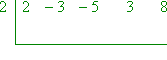
For this first exercise, I will display the entire synthetic-division process step-by-step.
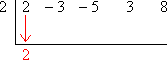
First, carry down the "2" that indicates the leading coefficient:
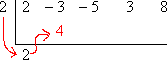
Multiply by the number on the left, and carry the result into the next column:
Add down the column:
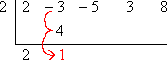
Multiply by the number on the left, and carry the result into the next column:
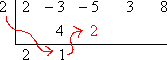
Add down the column:
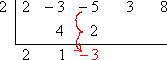
Multiply by the number on the left, and carry the result into the next column:
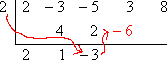
Add down the column:
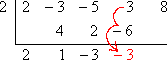
Multiply by the number on the left, and carry the result into the next column:
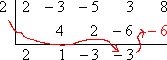
Add down the column for the remainder:
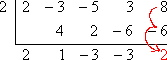
The completed division is:
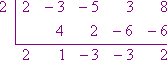
This exercise never said anything about polynomials, factors, or zeroes. But this division tells us that, if we divide the polynomial 2x4 − 3x3 − 5x2 + 3x + 8 by the linear divisor x − 2, then the remainder will be 2, and therefore x − 2 is not a factor of 2x4 − 3x3 − 5x2 + 3x + 8, and x = 2 is not a zero (that is, a root or x-intercept) of the initial polynomial.
Note: The divisor in synthetic division is not only linear, but it also has a leading coefficient of 1.
- Divide 3x3 − 2x2 + 3x − 4 by x − 3 using synthetic division. Write the answer in the form "".
This question is asking me, in effect, to convert an "improper" polynomial "fraction" into a polynomial "mixed number". That is, I am being asked to do something similar to converting the improper fraction to the mixed number , which is really the shorthand for the addition expression .
In order for me to convert the polynomial division into the required "mixed number" format, I have to do the synthetic division. I will show most of the steps.
First, I write down all the coefficients, and put the zero from x − 3 = 0 (so x = 3) at the left.
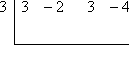
Next, I carry down the leading coefficient from the polynomial dividend (that is, the polynomial's coefficients inside the synthetic-division set-up):
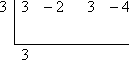
Now I multiply by the potential zero, carry the result up to the next column, and add down:
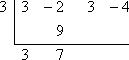
I repeat this process:
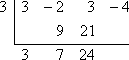
Lather, rinse, repeat:
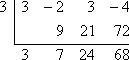
As you can see, the remainder is 68.
Since I started with a polynomial of degree 3 and then divided by x − 3 (that is, since I divided by a polynomial of degree 1), I am left with a polynomial of degree 2. Then the bottom line represents the polynomial3x2 + 7x + 24 with a remainder of 68. Putting this result into the required "mixed number" format, I get the answer as being:
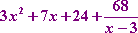
It is always true that, when you use synthetic division, your answer (in the bottom row) will be a polynomial of degree less, by one, than what you'd started with, because you have divided out a linear factor. I had started with a cubic, so I knew that my answer, denoted by the "3 7 24" in the bottom row, stood for a quadratic.
© 2024 Purplemath, Inc. All right reserved. Web Design by 