


|
|
||||||||||||
Angles
of Elevation / Inclination and Angles of elevation or inclination are angles above the horizontal, like looking up from ground level toward the top of a flagpole. Angles of depression or declination are angles below the horizontal, like looking down from your window to the base of the building in the next lot. Whenever you have one of these angles, you should immediately start picturing how a right triangle will fit into the description.
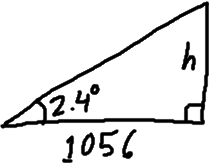
Two-tenths of a mile is 0.2×5280 feet = 1056 feet, so this is my horizontal distance. I need to find the height h of the cactus. So I draw a right triangle and label everything I know:
To the nearest foot, the saguaro is 44 feet tall.
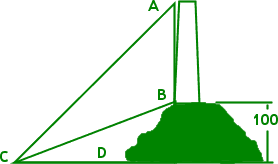
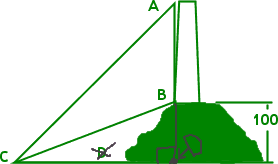
I'm going to have to work this exercise in steps. I can't find the height of the tower, AB, until I have the length of the base CD. (Think of D as being moved to the right, to meet the continuation of AB, forming a right triangle.) For this computation, I'll use the height of the hill. 100/|CD| = tan(30°) To minimize round-off error, I'll use all the digits from my calculator in my computations, and try to "carry" the computations in my calculator the whole way.. Now that I have the length of the base, I can find the total height, using the angle that measures the the elevation from sea level to the top of the tower. h/173.2050808 = tan(60°) Excellent! By keeping all the digits and carrying the computations in my calculator, I got an exact answer. No rounding! But I do need to subtract, because "300" is the height from the water to the top of the tower. The first hundred meters of this total height is hill, so: The tower is 200 meters tall. Original URL: http://www.purplemath.com/modules/incldecl.htm Copyright 2009 Elizabeth Stapel; All Rights Reserved. | ||||||||||||