


|
|
Graphing Trig Functions: Examples (page 2 of 3) Sections: Introduction, Examples with amplitude and vertical shift, Example with phase shift
The "minus" sign tells me that the graph is upside down. Since the multiplier out front is an "understood" –1, the amplitude is unchanged. The argument (the 3x inside the cosine) is growing three times as fast (because of the 3), so the period is one-third as long; the period for this graph will be (2/3)π. Here is the regular graph of cosine:
I need to flip this upside down, so I'll swap the +1 and –1 points on the graph:
...and then I'll fill in the rest of the graph:
And now I need to change the period. Rather than trying to figure out the points for the graph on the regular axis, I'll instead re-number the axis, which is a lot easier. The regular period is from 0 to 2π, but this graph's period goes from 0 to (2π)/3. Then the midpoint of the period is going to be (1/2)(2π)/3 = π/3, and the zeroes will be midway between the peaks and troughs. So I'll erase the x-axis values from the regular graph, and re-number the axis:
Notice how I changed the axis instead of the graph. You'll quickly get pretty good at drawing a regular sine or cosine, but the shifted and transformed graphs can prove difficult. Instead of trying to figure out all of the changes to the graph, just tweak the axis system.
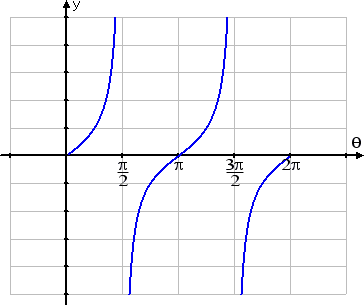
The regular tangent looks like this:
The graph for tan(θ) – 1 is the same shape, but shifted down by one unit. Rather than try to figure out the points for moving the tangent curve one unit lower, I'll just erase the original horizontal axis and re-draw the axis one unit higher:
Original URL: http://www.purplemath.com/modules/grphtrig2.htm Copyright 2009 Elizabeth Stapel; All Rights Reserved. |