



Negative Exponents
Purplemath
Once you've learned about negative numbers, you can also learn about negative powers.
A negative exponent just means that the base is on the wrong side of the fraction line, so you need to flip the base to the other side. In technical terms, the "minus" in the power means that you should convert the base expression to its reciprocal.
For instance, x−2 (pronounced as "ecks to the minus two") just means "x2, but underneath, so it's really ".
(Note: If an exercise of this sort just says "simplify", the unstated meaning is "restate, so that there are only positive exponents".)
- Write x−4 using only positive exponents.
I know that the negative exponent means that the base, the x, belongs on the other side of the fraction line. But there isn't a fraction line!
To fix this, I'll first convert the expression into a fraction in the way that any expression can be converted into a fraction: by putting it over 1. Of course, once I move the base to the other side of the fraction line, there will be nothing left on top. But since anything can also be regarded as being multiplied by 1, I'll leave an "understood" 1 on top.
Here's what my work looks like:
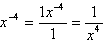
Once I no longer needed the 1 underneath (to create the fraction), I omitted it, because I had the variable expression underneath, and the "times 1" doesn't change anything.
- Write using only positive exponents.
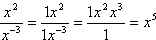
Only one of the terms has a negative exponent. This means that I'll only be moving one of these terms. The term with the negative power is underneath; this means that I'll be moving it up top, to the other side of the fraction line. There already is a term on top; I'll be using exponent rules to combine these two terms.
Once I move that denominator up top, I won't having anything left underneath (other than the "understood" 1), so I'll drop the denominator.
- Write 2x−1 using only positive exponents.
The negative power will become just 1 once I move the base to the other side of the fraction line. Anything to the power 1 is just itself, so I'll be able to drop this power once I've moved its base.
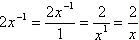
Make sure you understand why the 2 above does not move with the variable: the negative exponent is only on the x, so only the x moves.
- Write (3x)−2 using only positive exponents.
I've got a number inside the power this time, as well as a variable, so I'll need to remember to simplify the numerical squaring.
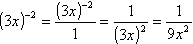
Unlike the previous exercise, the parentheses meant that the negative power did indeed apply to the number 3 as well as to the variable.
- Write using only positive powers.
The −1 power on the x in the numerator means that I'll need to move that x to the other side of the fraction line. But the "minus" on the 5 in the numerator means only that the 5 is negative. This "minus" is not a power, so it doesn't say anything about moving the 5 anywhere!
Moving *only* the one bit that actually needs to be moved, I get:
- Write using only positive exponents.
There is more than one way to do the steps for this simplification. I'll start by noting that the negative exponent on the outside of the parentheses means that the numerator should be moved underneath and the denominator should be moved on top. In other words, the fraction inside the parentheses should be flipped.
Once I've flipped the fraction and converted the negative outer power to a positive, I'll move this power inside the parentheses, using the power-on-a-power rule; namely, I'll multiply. In this case, this will result in negative powers on each of the numerator and the denominator, so I'll flip again. (Yes, I'm kind of taking the long way 'round.)
![[ x^(-2) / y^(-3) ]^(-2) = [ y^(-3) / x^(-2) ]^2 = [ y^(-6) ] / [ x^(-4) ] = (x^4)/(y^6)](exponent/exp06.gif)
The above simplification can also be done as follows:
![[ x^(×2) / y^(-3) ]^(-2) = [ x^(-2) ]^-2 / [ y^(-3) ]^(-2) = (x^4) / (y^6)](exponent/exp07.gif)
Instead of flipping twice, I noted that all the powers were negative, and moved the outer power onto the inner ones; since "minus times minus is plus", I ended up with all positive powers.
Note: While this second solution would be a faster way of getting the exercise done, "faster" doesn't mean "more right". Either way is fine; you do what works better for you.
Since exponents indicate multiplication, and since order doesn't matter in multiplication, there will often be more than one sequence of steps that will lead to a valid simplification of a given exercise of this type. Don't worry if the steps in your homework look quite different from the steps in a classmate's homework. As long as your steps were correct, you should both end up with the same answer in the end.
By the way, now that you know about negative exponents, you can understand the logic behind the "anything to the power zero" rule.
Why is anything to the power zero equal to 1?
There are various explanations for why anything to the power zero is just 1. One explanation might be stated as "because that's how the rules work out"; this might be called the "Because reasons" explanation.
A pattern-based explanation would be to trace through a progression like the following:
35 = 36 ÷ 3 = 36 ÷ 31 = 36−1 = 35 = 243
34 = 35 ÷ 3 = 35 ÷ 31 = 35−1 = 34 = 81
33 = 34 ÷ 3 = 34 ÷ 31 = 34−1 = 33 = 27
32 = 33 ÷ 3 = 33 ÷ 31 = 33−1 = 32 = 9
31 = 32 ÷ 3 = 32 ÷ 31 = 32−1 = 31 = 3
At each stage, the expression at the beginning of the line has a power than is 1 less than the beginning expression in the line above, and the simplified value was equal to the previous value divided by 3. Then following this pattern logically, since 3 ÷ 3 = 1, we must then have:
30 = 31 ÷ 3 = 31 ÷ 31 = 31−1 = 30 = 1
An exponents-based explanation of the "anything to the zero power is just 1" rule might be as follows:
m0 = m(n − n) = mn × m−n = mn ÷ mn = 1
This works because anything (other than zero) divided by itself is just "1".
Comment: Please don't ask me to "define" 00. There are at least two ways of looking at this quantity:
Anything to the zero power is "1", so 00 = 1.
Zero to any power is zero, so 00 = 0.
As far as I know, the math gods have not yet settled on a firm definition of 00 — though, to be fair, an informal consensus seems to be building that the value, by all rights, should be 1, and just about any programming language will spit out the value 1.
In calculus, 00 will be called an "indeterminate form", meaning that, mathematically, it makes no sense and tells you nothing useful. If this quantity comes up in your class, don't assume: ask your instructor specifically what you should do with it.
For loads more worked examples, try here. Or continue with this lesson; scientific notation comes next.
© 2024 Purplemath, Inc. All right reserved. Web Design by 