



The Binomial Theorem: The Formula
Purplemath
What is the Binomial Theorem for?
The Binomial Theorem is a quick way (okay, it's a less slow way) of expanding (that is, of multiplying out) a binomial expression that has been raised to some (generally inconveniently large) power. For instance, the expression (3x − 2) is a binomial, 10 is a rather large exponent, and (3x − 2)10 would be very painful to multiply out by hand.

The Binomial Theorem can also be used to find one particular term in a binomial expansion, without having to find the entire expanded polynomial.
Thankfully, somebody figured out a formula for this expansion, and we can plug the binomial 3x − 2 and the power 10 into that formula to get that expanded (that is, multiplied-out) form.
What is the formula for the Binomial Theorem?
The formal expression of the Binomial Theorem is as follows:
![(a + b)^n = sum[k=0,n][(n over k)a^(n-k)b^k]](prob/binom01.gif)
Yeah, I know; that formula never helped me much, either. Who can make heads or tails of it, and how are you supposed to remember it for the test? And it certainly doesn't help that different texts may use different notations to mean the exact same thing.
The parenthetical bit in the formula above comes to us from probability and statistics, and has these equivalent forms:
![(n over k) = nCk = n!/[(n-k)!k!]](prob/binom02.gif)
Recall that the factorial notation "n!" means "the product of all the whole numbers between 1 and n". So, for instance, 6! means 1×2×3×4×5×6.
From this definition, we can see that the notation "10C7" (often pronounced as "ten, choose seven") evaluates as follows:
![10_C_7 = 10! / [(10 - 7)! 7!] = 10! / [3!7!] = [8 × 9 × 10] / [2 × 3] = [4 × 3 × 10] / [1] = 120](prob/binom03.png)
Many calculators can evaluate this "n choose m" notation for you. Just look for a key that looks like "nCm" or "nCr", or for a similar item on the "Prob" or "Math" menu, or check your owner's manual under "probability" or "combinations".
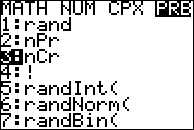
The evaluation will probably look something like this:

There is another way to find the value of "nCr", and it's called "Pascal's Triangle". To make the triangle, you start with a pyramid of three 1's, like this:

Then you get the next row of numbers by adding the pairs of numbers from above. (Where there is only one number above, you just carry down the 1.)

Keep going, always adding pairs of numbers from the previous row.
To find, say, 6C4, you go down to the row where there is a "6" after the initial "1", and then go over to the 5th (not the 4th) entry, to find that 6C4 = 15.
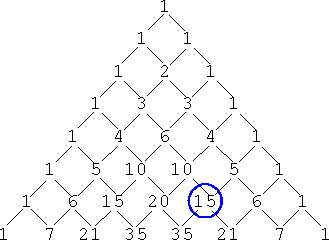
As you might imagine, drawing Pascal's Triangle every time you have to expand a binomial would be a rather long process, especially if the binomial has a large exponent on it. People have done a lot of studies on Pascal's Triangle, but in practical terms, it's probably best to just use your calculator to find nCr, rather than using the Triangle.
I mean, yes, the Triangle is cute, I suppose, but it's not terribly helpful in this context, being more time-consuming than anything else. For instance, on a test, do you want to evaluate "10C7" by calculating eleven rows of the Triangle, or by pushing just a few buttons on your calculator?

I could never remember the formula for the Binomial Theorem, so instead I just learned how it worked. I noticed that the powers on each term in the expansion always added up to whatever n was, and that the terms counted up from zero to n.
What is an example of expanding using the Binomial Theorem?
Let's return to our initial example of (3x − 2)10, and see what the expansion looks like.
First, note that the powers on every term of the expansion will add up to 10. Second, note that the powers on the terms will increment by counting up from zero to 10; yes, just as with Javascript, we start from zero, not from one. Third, note that this means that there will be eleven terms in the expansion, not just ten.
My first-pass work looks like this:
(3x − 2)10 = 10C0 (3x)10−0(−2)0 + 10C1 (3x)10−1(−2)1
+ 10C2 (3x)10−2(−2)2 + 10C3 (3x)10−3(−2)3 + 10C4 (3x)10−4(−2)4
+ 10C5 (3x)10−5(−2)5 + 10C6 (3x)10−6(−2)6 + 10C7 (3x)10−7(−2)7
+ 10C8 (3x)10−8(−2)8 + 10C9 (3x)10−9(−2)9 + 10C10 (3x)10−10(−2)10
Note how the highlighted counter-number counts up from zero to 10, with the factors on the ends of each term having the counter number, and the factor in the middle having the counter-number subtracted from 10. This pattern is all you really need to know for the Binomial Theorem; this pattern is how it works.
Your first step, given a binomial to expand, should be to plug it into the Theorem, just like I did above. Don't try to do too many steps at once. Only after you've set up your binomial in the Theorem's pattern should you start to simplify the terms. The Binomial Theorem works best as a "plug-n-chug" process, but you should plug first, chug later.
I've done my plugging above; now my second-pass chugging gives me the following:
(1)(59049)x10(1) + (10)(19683)x9(−2) + (45)(6561)x8(4) + (120)(2187)x7(−8)
+ (210)(729)x6(16) + (252)(243)x5(−32) + (210)(81)x4(64)
+ (120)(27)x3(−128) + (45)(9)x2(256) + (10)(3)x(−512) + (1)(1)(1)(1024)
At this point, I grab my calculator for all the multiplications I need to do. My final pass results in:
59049x10 − 393660x9 + 1180980x8 − 2099520x7 + 2449440x6 − 1959552x5
+ 1088640x4 − 414720x3 + 103680x2 − 15360x + 1024
As painful as the Binomial Theorem's process is, it's still easier than trying to multiply this stuff out by hand. So don't let the Formula put you off. It's just another process to memorize, so memorize it, at least for the next test.
And, as distasteful as the prospect may seem, it would probably be a really good idea to do a bunch of extra practice problems, so that the process feels fairly automatic by the time you hit the next test.
© 2024 Purplemath, Inc. All right reserved. Web Design by 